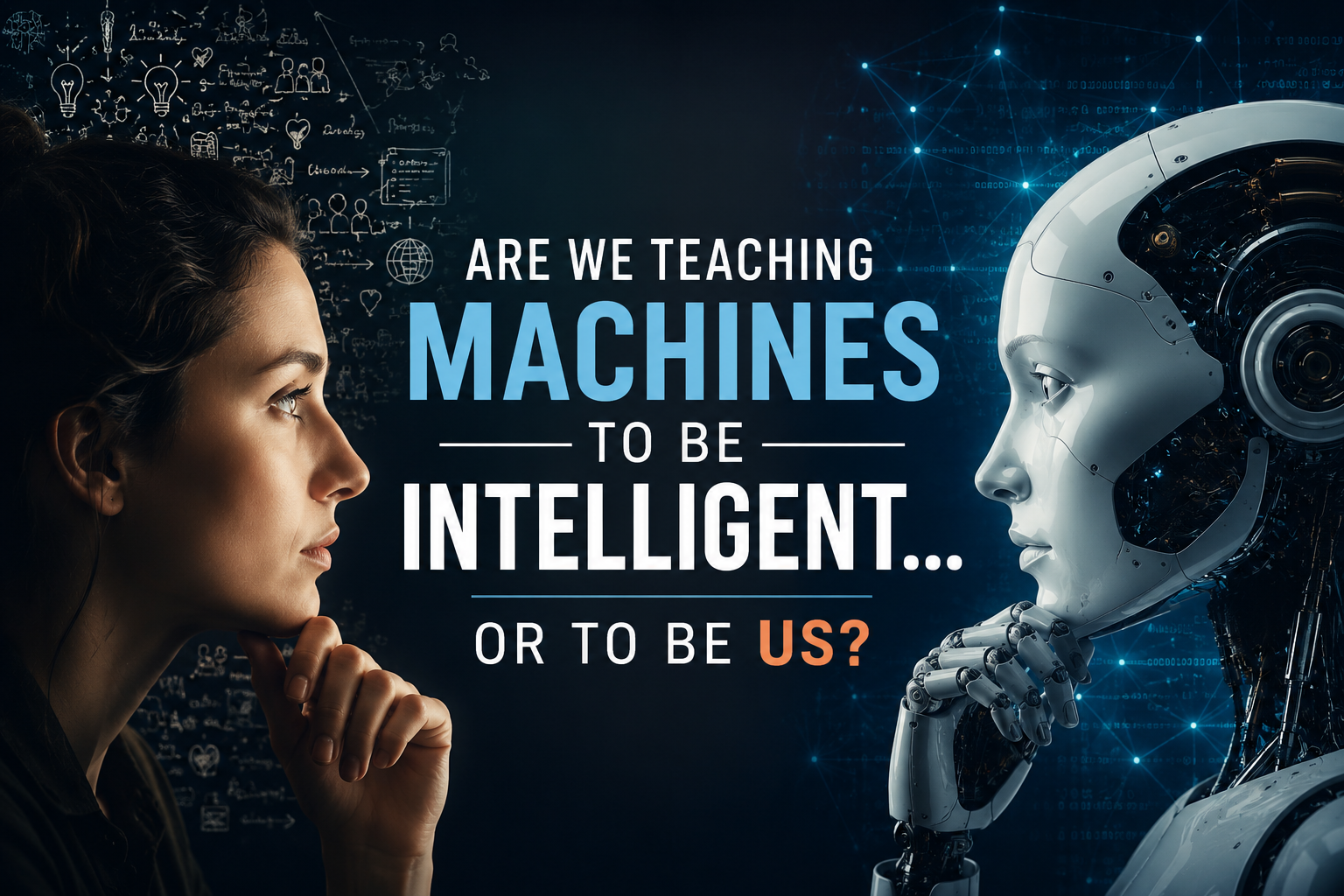
Every time a chatbot gives you a surprisingly thoughtful answer, there’s a temptation to say, “Wow, it actually understands.” But does it? Or did we just teach it to sound like someone who does?
That question sounds philosophical at first. But the more AI shows up in real life, the more practical it becomes. Because what we’re really asking is: when we build these systems, what exactly are we building toward?
The Difference Between Learning and Mimicking
Here’s a simple scenario. You show a child a thousand pictures of dogs. They eventually learn what makes a dog a dog, not just the ears or the fur, but something more general. They can spot a dog in a cartoon, a shadow, or a blurry photo.
AI systems do something similar, but the process underneath is very different. They find statistical patterns. They learn what pixels or words tend to appear together. It works remarkably well. But is that the same as understanding?
The honest answer is: we don’t fully know. And that uncertainty is at the center of everything happening in AI right now.
When researchers talk about machine intelligence, they often split into two camps. One side says intelligence is about behavior. If a machine does intelligent things, it is intelligent. The other side says behavior isn’t enough. There has to be something going on inside, some form of reasoning or awareness, not just pattern-matching at scale.
Neither side has fully convinced the other.
What We Actually Feed These Systems
To train a large language model, you need text. Lots of it. Books, articles, websites, forums, code, conversation transcripts. Basically, the written output of human thought over decades.
So when the model learns to write, argue, explain, or joke, it’s learned from us. It studied how we structure sentences when we’re confused. How we hedge when we’re not sure. How we get enthusiastic when something excites us.
That’s not intelligence in the abstract. That’s a reflection of human intelligence specifically.
Which raises a strange question. If a machine gets good at being human, is it becoming intelligent, or is it just becoming a very good impersonation of us?
- It can explain photosynthesis, but it learned that from biology teachers who wrote it down.
- It can write poetry, but it learned meter and metaphor from poets who came before.
- It can give advice, but it learned that from advice columns, self-help books, and therapy transcripts.
Every output traces back to a human original. That doesn’t make it worthless. But it does make the word “intelligent” worth examining more carefully.
The Mirror Problem
There’s something called the mirror problem in AI. Not an official term, just a useful way to think about it.
When you talk to an AI and it responds in a way that feels warm or clever, you’re partly reacting to yourself. The system learned from humans. It’s giving you back something shaped by human expression. So of course it feels familiar. Of course it feels intelligent.
You’re essentially talking to a very complex echo.
That’s not a criticism. Echoes can be useful. They can be beautiful, even. But mistaking an echo for a voice is a different thing entirely.
This matters practically. If we design AI systems around the assumption that they think the way we do, we’ll be surprised when they fail in ways no human would. They don’t get tired and make careless errors for the same reason we do. They don’t feel social pressure to double-check their work. They don’t have a gut feeling that something is off.
They approximate all of those things. But approximation and the real thing behave differently at the edges.
Where It Gets Interesting: When Machines Surprise Us
Here’s where I’ll push back on my own argument a little.
Sometimes AI systems do things nobody explicitly taught them. They find solutions to math problems using steps researchers hadn’t considered. They identify patterns in protein structures that took scientists years to notice. In certain narrow domains, they seem to go beyond what was modeled in their training data.
Is that intelligence? Or is it just very fast, very thorough pattern recognition working at a scale humans can’t match?
Honestly, it might be both. Or the line between those two things might not be as clear as we assumed.
The uncomfortable possibility is that what we call intelligence has always been, in part, sophisticated pattern recognition. We just run it on biological hardware with emotions, memory, embodied experience, and motivation. Maybe the machines are doing something genuinely similar, just without most of those layers.
Or maybe those layers are what make intelligence real, and without them, it’s something else entirely.
Why It Matters More Than It Seems
If we’re teaching machines to be us, then AI reflects our values, our biases, our blind spots, and our gaps. That’s already happening. AI systems trained on human data have reproduced racial bias, gender stereotypes, and cultural assumptions embedded in that data.
We didn’t program that in. It arrived with the training. Because we trained on ourselves.
That means the question of whether we’re building machine intelligence or a mirror of human intelligence isn’t just philosophical. It’s a design question. A safety question. An ethics question.
If it’s a mirror, we need to think hard about what we’re reflecting. And whether we want those reflections making decisions, writing diagnoses, or shaping what people read and believe.
So, What Are We Actually Building?
My take, for what it’s worth: we’re doing both at once, and we haven’t fully separated the two.
We’re building systems that can do things no single human could do, processing millions of documents, generating code in seconds, spotting signals in massive datasets. That part feels new.
But we’re building those systems almost entirely from human-generated material, shaped by human feedback, evaluated by human standards of what a good answer looks like.
We’re not building an alien intelligence. We’re building an amplified, accelerated version of our own collective thinking. Which is genuinely remarkable. And genuinely worth being careful with.
The question isn’t really machines versus humans. It’s whether we understand what we’ve made well enough to use it wisely. And right now, the honest answer is: we’re still figuring that out.