A few years ago, ordering food through an app felt futuristic. Now your phone predicts what you want before you even type it. Cars can park themselves. AI writes emails. Warehouses run with barely any human workers.
So it raises a strange question.
What happens to people when machines start doing almost everything better, faster, and cheaper?
That question sounds dramatic until you notice how normal automation already feels. Most of us barely react to it anymore.
And honestly, that might be the biggest shift of all.
The Real Fear Is Not Losing Jobs
People often talk about automation like it’s only about employment. Truck drivers replaced by self driving systems. Cashiers replaced by kiosks. Writers competing with AI tools.
But work is only one part of human identity.
A lot of people wake up each day because they feel needed. Their routines give structure to life. Without that sense of contribution, things can get emotionally complicated very quickly.
Imagine someone who spent 30 years mastering a skill, only to watch software do it in seconds.
That hurts in a way technology discussions rarely mention.
Humans May Move Toward More Human Things
Here’s the interesting part though.
Every time machines take over repetitive tasks, humans usually shift toward things that feel more personal.
Not perfect. Not efficient. Human.
We already see it happening:
- Handmade products are valued more than factory items
- People pay extra for human customer support
- Live experiences matter more in a digital world
- Authentic storytelling beats polished corporate content
Maybe the future becomes less about productivity and more about meaning.
That sounds idealistic, but maybe automation pushes us there naturally.
A World Full of Free Time Sounds Great, Until It Isn’t
Most people dream about having more free time.
Then they get a long vacation and feel restless after three days.
Humans are not very good at doing nothing.
If automation removes most labor, society could face a strange emotional problem. People may struggle with direction more than survival.
You can already see hints of this online. Endless scrolling. Constant distraction. People searching for purpose in productivity apps and side hustles.
When Everything Becomes Automated? the biggest shortage might not be money.
It could be meaning.
The New Status Symbol Could Become Creativity
In the past, physical labor had value. Then knowledge work became powerful. Now AI is starting to handle parts of both.
So what becomes valuable next?
Possibly original thinking.
Not because machines cannot generate content, they clearly can. But because humans still connect deeply with lived experience, emotion, and perspective.
A song written after heartbreak hits differently when you know a real person felt it.
A story told by someone who struggled feels more alive than perfectly optimized content.
People may stop asking, “Was this made efficiently?”
They may ask, “Was this real?”
The Automation Gap Could Divide Society
Not everyone will experience automation the same way.
Some people will use AI tools to build businesses, save time, and gain freedom. Others may feel left behind very quickly.
That gap could become one of the biggest social challenges of the next decade.
Think about older workers trying to adapt to tools changing every few months. Or younger generations growing up in a world where basic skills are outsourced to software.
There’s also a risk that convenience slowly weakens curiosity.
If AI answers everything instantly, do people stop exploring deeply on their own?
That possibility feels more concerning than robots taking over factories.
A Small Real Life Example
Last month, a friend told me he no longer writes his own emails. AI drafts them. His calendar organizes itself. Even meeting notes are summarized automatically.
At first he loved it.
Then he admitted something strange.
He felt less mentally present during the day because fewer things required real attention.
That stuck with me.
Convenience saves effort, but effort is often where engagement comes from.
Maybe Humans Become More Selective
The future probably will not turn humans into lazy spectators sitting around while robots do everything.
More likely, people become more selective about where they spend energy.
Machines may handle repetition.
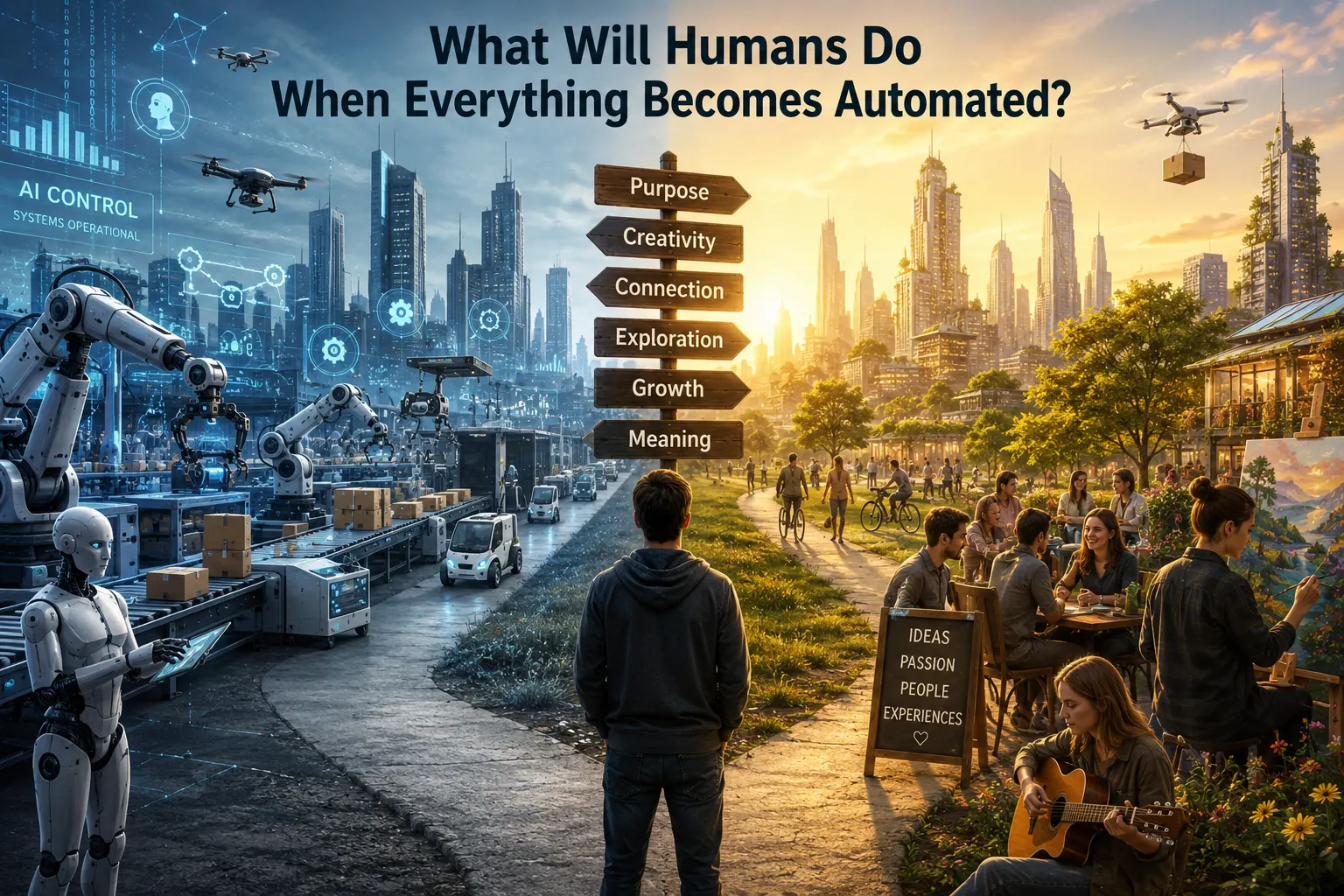
Humans may focus on:
- Relationships
- Creativity
- Experiences
- Personal growth
- Exploration
- Emotional connection
At least, that’s the hopeful version.
The Future Might Feel Emotionally Different
Most conversations about automation focus on economics and technology.
But I think the emotional side matters just as much.
When Everything Becomes Automated? people may spend less time asking how to survive, and more time asking why they exist, what matters, and what actually feels fulfilling.
That sounds philosophical, but maybe automation forces humanity into that conversation whether we want it or not.
And honestly, we are probably less prepared for that question than we think.