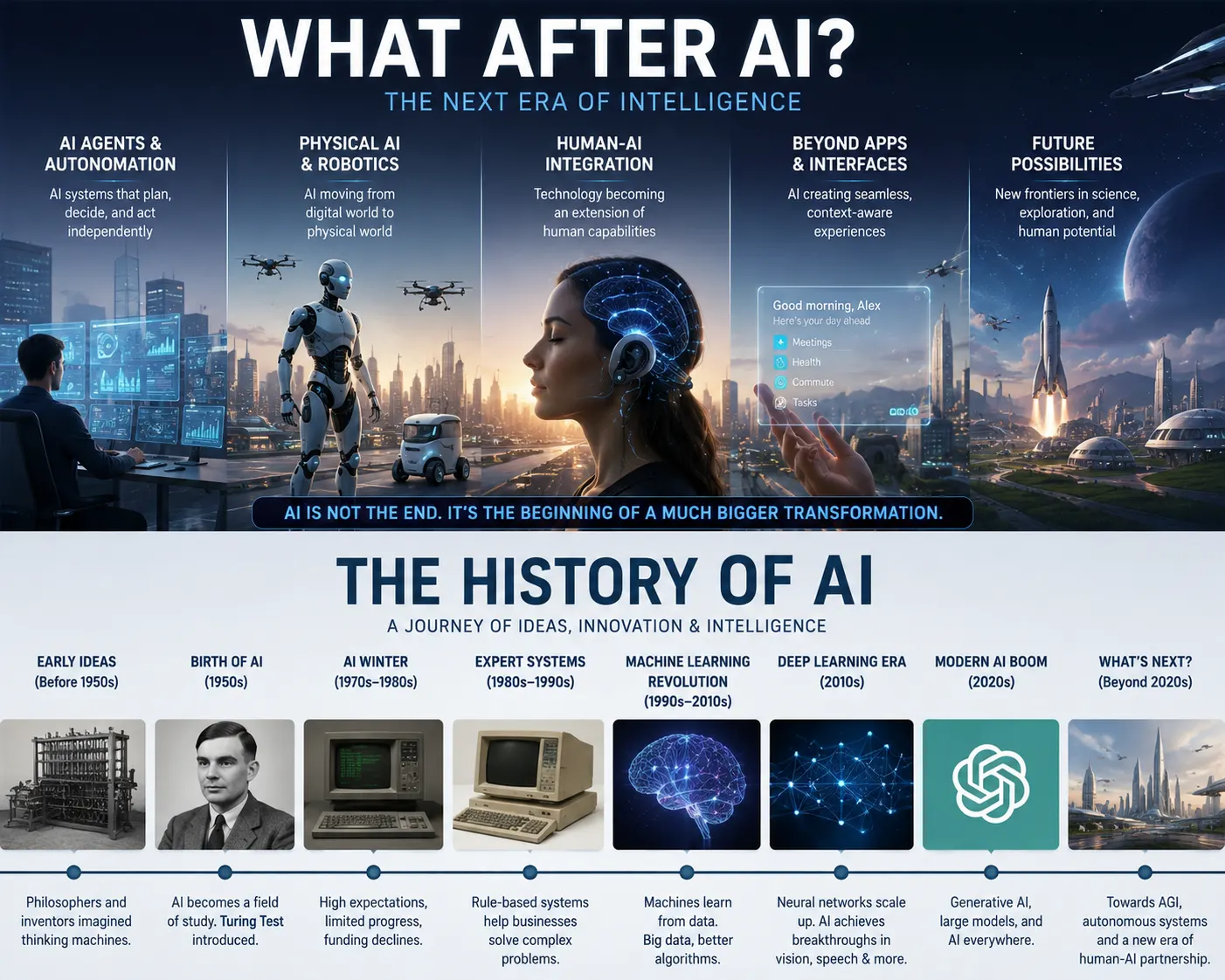
We are all deep in the AI conversation right now. New tools, new models, new fears, new excitement. But here is a thought that does not get enough space: what happens after AI?
Not after AI fails. Not after we get bored of it. But after it becomes so woven into daily life that we stop thinking of it as technology and just call it Tuesday.
That is actually the more interesting question.
When a Technology Disappears Into the Background
Think about electricity. At some point, people were stunned by it. There were articles, debates, fears about what it would do to jobs and society. Then one day, nobody thought about electricity anymore. It was just there. You flipped a switch.
AI is heading somewhere similar, at least partially. The part of AI that helps you write emails, summarize documents, or recommend a playlist, that part will become invisible. It will be baked into every product, every interface, every workflow. People will stop noticing it. If you want to understand why that shift feels so sudden, it helps to look at the full history of AI and see just how long this has been building.
But what fills the space that used to be taken up by figuring out how to use AI?
The Human Skills That Start Mattering More
Here is where it gets interesting. When AI handles the routine, the mechanical, the repetitive, the stuff that genuinely rises to the top is the stuff AI cannot fake very well.
Things like:
- Genuine judgment in situations where the stakes are real and the context is messy
- Trust-building between people, which still requires human presence
- Creative leaps that come from lived experience, not pattern matching
- Emotional intelligence in moments that need actual empathy, not simulated empathy
None of that is new. But after AI, those skills become the differentiator in a way they have not been before.
If your value is in doing fast, repetitive, predictable work, AI will compete with you directly. If your value is in navigating complexity, building relationships, and making calls in genuinely uncertain situations, you actually get more valuable as AI spreads.
New Problems That AI Will Create (and That Need Solving)
Every major technology shift creates a new layer of problems. The internet gave us spam, misinformation, and digital addiction. Smartphones gave us distraction at scale, privacy erosion, and a whole new mental health conversation.
After AI settles in, the new problems are probably going to look something like this:
Trust and verification. When AI can write, speak, and generate video convincingly, how do you know what is real? This is already a question, but it becomes a much louder one. There will be entire industries built around proving authenticity.
Meaning and purpose. This one sounds abstract, but it is not. If AI can produce a poem, a song, a business plan in seconds, what does it mean to make something? People are going to wrestle with this. Some already are.
Access and inequality. AI tools are not equally distributed. The gap between people who can use them well and people who cannot will create real-world consequences in hiring, education, and economic opportunity.
These are not reasons to fear what after AI looks like. They are just honest problems that come with progress.
A World That Thinks Differently
There is a slightly bigger shift worth sitting with. AI is changing how people think, not just what they do.
When you know a tool can generate ten options in seconds, you start to think differently about exploration and iteration. When summarization is instant, you start to consume information differently. When answers come fast, your tolerance for sitting with uncertainty gets shorter.
After AI becomes normal, there is going to be a cultural reckoning with attention, depth, and patience. Some people will push back hard and treat slow, careful thinking as a premium skill. Others will lean fully into speed and volume.
Both of those things will coexist, and honestly, that tension is going to produce some interesting art, philosophy, and policy debates.
What This Means for You Right Now
You do not have to wait for some post-AI future to start thinking about this. The positioning starts now.
What are you building, practicing, or getting known for that goes beyond what a model can replicate? That is worth real thought. Not in a panicked way. More like the way you would think about any career or creative investment.
The people who do well after AI will not necessarily be the ones who used AI the most. They will be the ones who understood what it was for and what it was not for, and built their life around the parts that stayed human.
What do you think comes next? Not in a tech sense, but in a human sense. That might be the more useful conversation to have right now.