
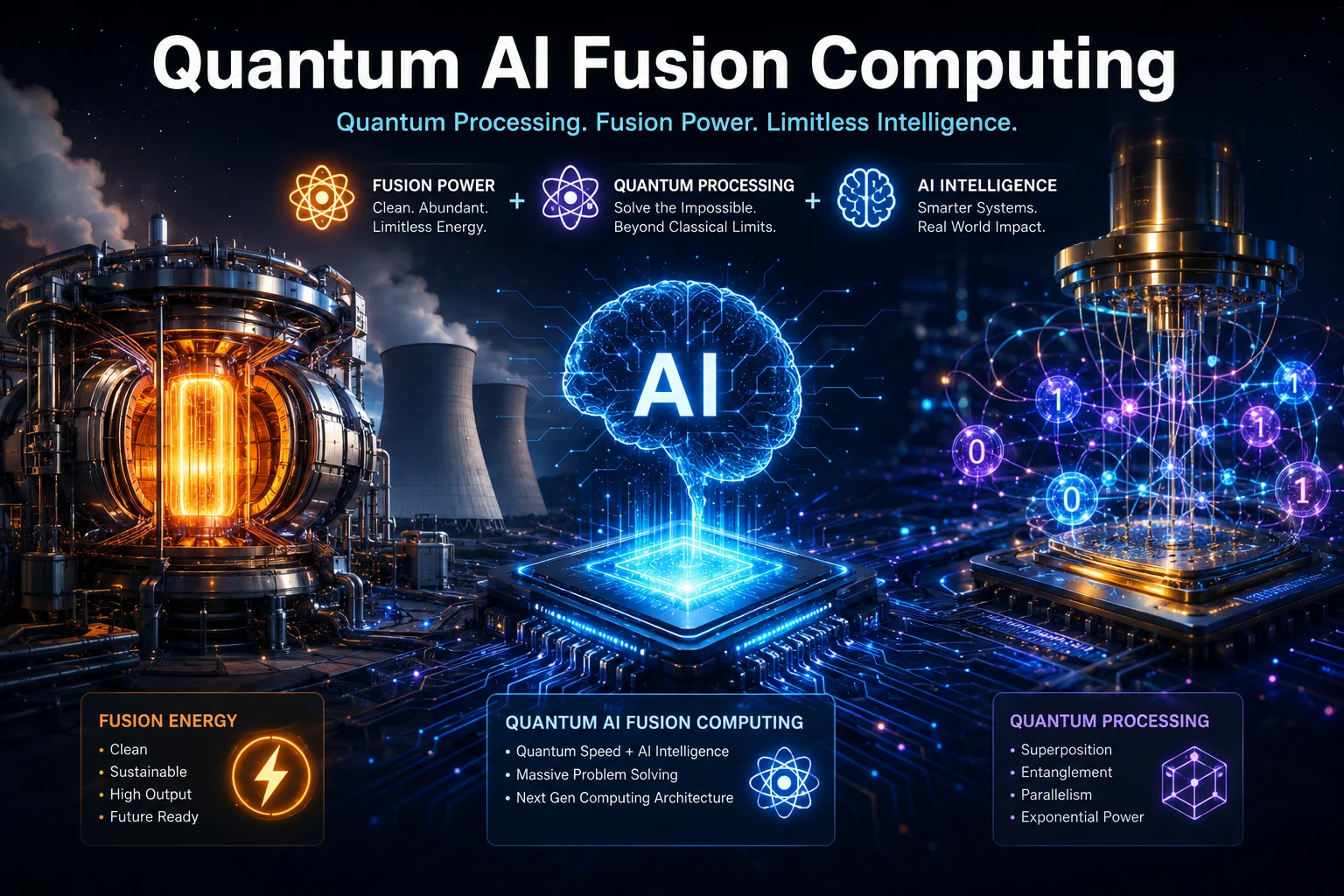
Have you ever looked at how fast AI is growing and thought, where does this actually end? Now imagine mixing that with quantum processing and fusion power. That is where things start feeling less like tech news and more like science fiction that is slowly becoming uncomfortable real.
The idea of quantum AI fusion computing sounds almost made up, but it is the kind of concept people in advanced research circles quietly explore. Not because it is fully here yet, but because it might reshape everything if it ever works at scale.
This raises a deeper question that connects closely with broader societal change: What Will Humans Do When Everything Becomes Automated?
The strange overlap of AI, quantum processing, and fusion energy
Most people think of AI as software and quantum computing as futuristic hardware. Fusion power sits in a completely different lane as an energy dream that could replace traditional grids.
But what happens when these three collide?
- AI needs massive energy and compute power
- Quantum systems promise new types of computation
- Fusion power could theoretically supply near-limitless clean energy
Put together, quantum AI fusion computing becomes a thought experiment about what happens when intelligence is no longer limited by energy scarcity or classical processing limits.
It is not about what exists today. It is about what becomes possible if constraints disappear.
And that leads directly into a more uncomfortable layer of the discussion: Are We Teaching Machines to Be Intelligent or to be Us?
Why people are even talking about this idea
Honestly, a few years ago this would have sounded like pure fantasy. But now, each piece is slowly becoming real in isolation.
Quantum research is progressing, AI models are getting heavier, and fusion projects are no longer just lab dreams.
A relatable way to think about it is this:
Imagine running a simulation so large that it normally crashes your computer. Now imagine a system where compute power and energy are no longer the bottleneck. That is the direction this conversation is pointing toward.
This is where the term quantum AI fusion computing starts getting used as a kind of shorthand for “post-limitation computing.”
The practical confusion most people have
Here is where things get messy. A lot of people assume this means we will soon have super smart AI running on quantum fusion super machines.
That is not how it works.
Some common misunderstandings:
- Quantum computers are not just faster AI chips
- Fusion energy is not plug and play electricity yet
- AI cannot simply “plug into quantum systems” and level up
The overlap is mostly theoretical and experimental at this stage. Still, it is easy to see why the phrase spreads. It sounds like the next logical step, even if reality is far more fragmented.
A real world way to picture it
Let us ground this a bit.
Think about a weather simulation system trying to predict global climate patterns. Today, even supercomputers simplify a lot.
Now imagine:
- AI helping interpret patterns in real time
- Quantum systems handling complex probability models
- Fusion power removing energy constraints for large scale simulations
That is a simple mental picture of what quantum AI fusion computing might eventually support.
Not a product. More like an extreme capability scenario.
The uncomfortable question nobody agrees on
If systems like this ever become possible, the question is not just technical.
It becomes philosophical.
Do we actually want intelligence systems that are not limited by energy or traditional computing boundaries?
And who controls something that powerful?
It is one thing to talk about innovation. It is another to think about scale without limits.
Closing thought
Right now, quantum AI fusion computing sits in that blurry space between research, imagination, and long term speculation. But it is interesting because each part of it is slowly becoming less imaginary on its own.
Maybe the real story is not whether it exists yet, but whether we are ready for what it implies.
And that question is still wide open.