
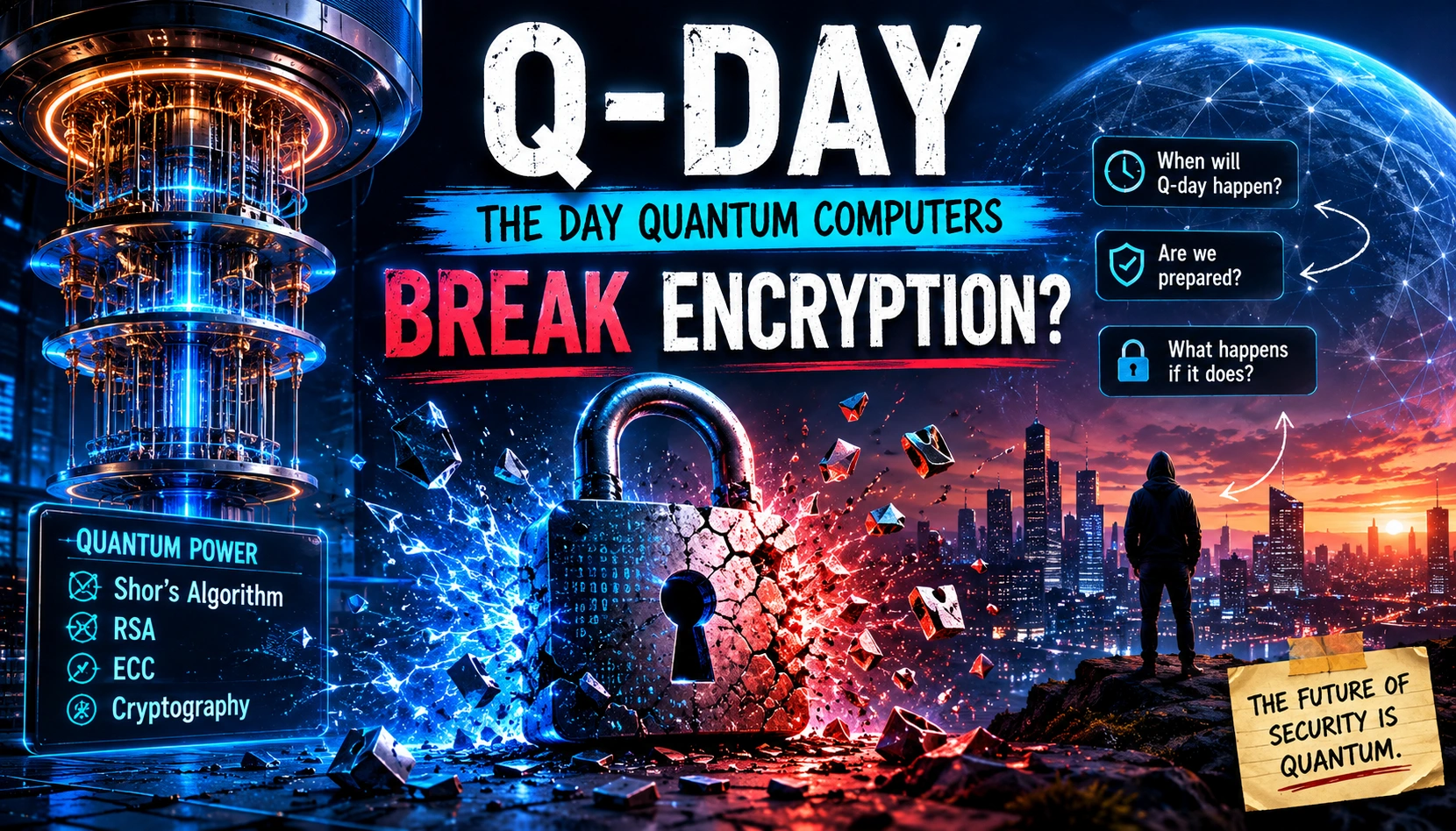
There is a thread floating around online that genuinely made people stop scrolling. Not because it had memes or drama, but because of what it was describing. Someone laid out the concept of Q-Day in plain language, and the replies went from confused to alarmed in about twelve comments flat.
If you have stumbled across a q day thread yourself, you probably understand why people react that way. It is one of those topics that sounds like science fiction until you realize it is not.
So What Exactly Is Q-Day?
Q-Day is the term used for the moment when a quantum computer becomes powerful enough to break the encryption systems that protect pretty much everything digital. We are talking about bank accounts, medical records, government communications, private messages, and more.
Right now, those systems are secure because cracking them would take a classical computer millions of years. A quantum computer, operating on entirely different physics, could do it in hours or minutes.
NIST, the National Institute of Standards and Technology, describes this as one of the most significant cryptographic challenges of our era. They launched a multi-year competition to develop quantum-resistant encryption and released the first finalized standards in August 2024.
The problem is that building the infrastructure to adopt those new standards takes years. Sometimes decades.
Why Does a Q Day Thread Go Viral?
Because when someone explains this clearly and without jargon, it hits differently.
Most people assume encryption just… works. They trust the padlock in their browser. They assume their messages are private. A well-written q day thread breaks that assumption wide open, and it does it fast.
The reactions tend to follow a pattern:
- First comes disbelief (“This sounds like clickbait”)
- Then comes the “wait, actually?” moment
- Then comes the slightly unsettled feeling that nobody in a suit on TV has warned them about this
One of the most unnerving parts of the whole discussion is what researchers call “harvest now, decrypt later.” According to Fortinet’s security research, threat actors and state-level adversaries may already be collecting encrypted data today with plans to decrypt it once quantum computers are capable enough. Your emails from five years ago. Private financial data. Classified government communication. All potentially sitting in cold storage, waiting.
That detail alone is what sends most threads into overdrive.
When Could This Actually Happen?
This is where the thread debates get heated.
Some researchers are cautious. The Global Risk Institute’s Quantum Threat Timeline 2024 found that most specialists expect a cryptographically relevant quantum computer sometime in the 2030s. Even in optimistic forecasts, the chance of it happening within ten years sits below 20 percent, according to Palo Alto Networks’ cybersecurity analysis.
Others are less relaxed about it. Google predicted that by 2029, quantum computers could crack some forms of encryption, according to reporting by CyberScoop. And in early 2026, three research papers published in quick succession dramatically reduced the estimated quantum resources needed to break RSA encryption, as reported by The Quantum Insider.
What was once thought to require 20 million qubits might now require fewer than one million.
That shift is not a small footnote. It changed how the security community is reading the timeline.
The Part No One Wants to Talk About
There is a detail buried in most serious discussions of Q-Day that gets skipped in casual threads. When a nation or organization achieves cryptographically relevant quantum computing, they will almost certainly not announce it.
The Quantum Threat Timeline Report put it bluntly: the real Q-Day may arrive without warning, as states or bad actors seek to exploit the advantage strategically before anyone realizes what happened.
Think about that for a second.
This is not like a product launch. There is no press conference. No press release. The day your encryption breaks might look exactly like every other Tuesday, at least for a while.
That is the part that tends to sober up even the most skeptical people in any q day thread.
What Is Actually Being Done About It?
Quite a bit, honestly. And this is where threads usually shift from panic to something more practical.
Post-Quantum Cryptography (PQC) is the leading response. NIST finalized three core algorithms in 2024:
- ML-KEM (FIPS 203)
- ML-DSA (FIPS 204)
- SLH-DSA (FIPS 205)
A fifth algorithm, HQC, was added in March 2025 as a backup approach. Companies like Google and Cloudflare are already pushing for faster adoption, and the White House has recommended 2035 as a target year for entities to complete their migration to post-quantum cryptography, according to CNN’s reporting.
Quantum Key Distribution (QKD) is another method, using the laws of physics rather than mathematical complexity to secure communications. It requires specialized hardware and is harder to deploy at scale, but it is being actively developed.
The challenge is not inventing the solution. The solutions exist. The challenge is deploying them fast enough across millions of systems, many of which were built decades ago and were never designed to be easily updated.
What Should Regular People Actually Do?
Here is where the online discourse gets a little messy. Some threads veer into doomsday territory. Others wave it off entirely.
The honest answer sits somewhere in the middle.
For most individuals, the immediate action is awareness, not panic. But there are a few practical things worth thinking about:
- Ask your software providers if they have a quantum readiness roadmap. Larger banks, cloud services, and communication platforms should already be working on this.
- Be cautious about long-term sensitive data. Anything you send today that needs to stay private for 10 or more years is theoretically at risk from harvest-now-decrypt-later attacks.
- Pay attention to the standards conversation. When browsers and operating systems start rolling out PQC by default, update. Do not delay software updates.
IBM’s 2025 quantum-safe readiness report found that the global average quantum readiness score sits at only 25 out of 100. That means most of the world is not ready. Whether that changes before Q-Day arrives is genuinely unclear.
It Is Worth Paying Attention To
The q day thread that keeps circulating is not alarmism for its own sake. It is people who understand the technical details trying to explain something important in plain language.
The math is real. The timeline is uncertain, but it is not distant enough to ignore. And the thing about encryption is that it does not degrade slowly. It either works or it does not.
The good news is that the cryptography community saw this coming years ago and has been building the response. The not-so-good news is that deploying that response across global infrastructure is a massive, slow-moving project.
So maybe the best thing to take away from any Q-Day thread is not fear. It is a nudge to stay informed. Because this one is worth understanding before it becomes front-page news.