Most people assume the early internet is just gone. Buried under decades of redesigns, dead links, and abandoned servers. But here is something that might actually surprise you: the first website ever created is still online today, sitting quietly at the same address it has always had.
No nostalgia filter. No museum replica. The real thing.
So what is it, how did it get there, and why does it matter that it survived?
What Was the First Website, Exactly?
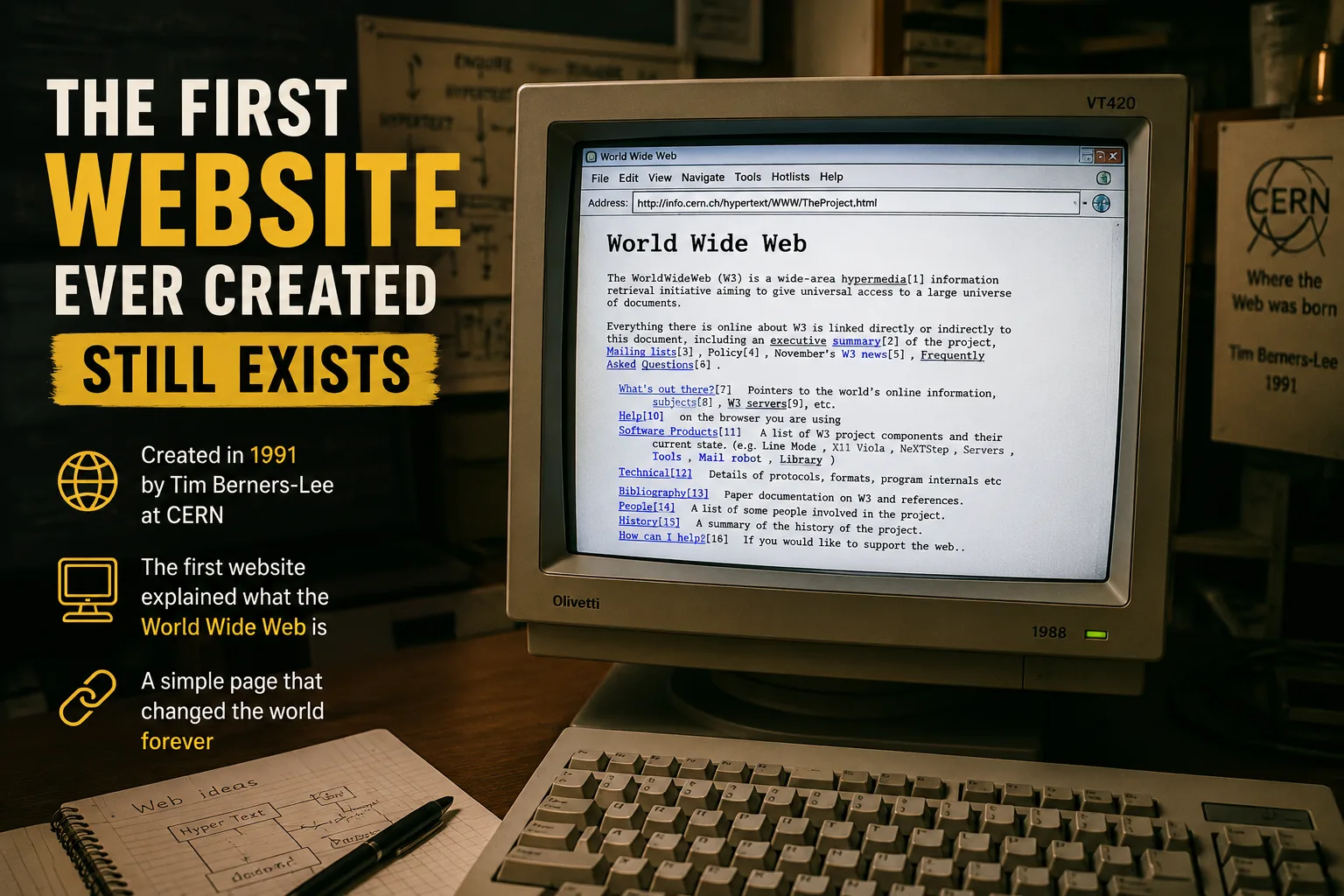
The first website ever created went live on August 6, 1991. It was built by Tim Berners-Lee, a British scientist working at CERN, the particle physics laboratory in Switzerland.
The site was not built to sell anything, entertain anyone, or go viral. It was purely informational. Its entire purpose was to explain what the World Wide Web was and how people could use it.
You can still visit it today at: info.cern.ch/hypertext/WWW/TheProject.html
And when you do, do not expect much. It is plain text with blue hyperlinks on a white background. No images. No navigation menu. No logo. Just words and links, which is honestly the most honest version of what a webpage can be.
Why Did Anyone Bother Keeping It?
This is the part people rarely ask. Servers get replaced. Domains expire. Companies fold. Yet this page has stayed up for over thirty years.
CERN made a deliberate decision in 2013 to restore and preserve the original site at its original URL. They called it the World Wide Web project, and part of the goal was to give people a fixed point in history they could actually visit.
Think about that for a second. Most of us cannot visit the first McDonald’s or the first Apple store in its original form. But you can visit the first website. Right now. In your browser. For free.
That is genuinely unusual in the way that human history works.
What the Page Actually Says
The original content is surprisingly readable. It explains the concept of hypertext, describes how to set up a web server, and lists the goals Berners-Lee had in mind for the web.
Some highlights from the page that still hold up:
- It refers to the web as “a wide-area hypermedia information retrieval initiative”
- It explains that the web allows users to “browse” information stored on remote machines
- It includes links to technical documentation written for scientists, not regular users
What strikes most people when they visit is how humble it is. There was no announcement. No countdown. No press release. One day the web existed, and this page was how you found out.
You can also explore modern web creation on our web development page.
The Web Was Supposed to Be Different
Here is something worth sitting with. Berners-Lee did not patent the web. He gave it away.
CERN released the underlying web technology into the public domain in 1993. No licensing fees. No royalties. No corporate ownership. Anyone could build on it.
That decision is a huge reason the web grew so fast. And it is also why a physics lab in Switzerland ended up accidentally creating the foundation for social media, e-commerce, streaming, and whatever the internet has become today.
The first website is a reminder of what the original intention was: open, free, and built for sharing information.
Whether we stuck to that vision is a different conversation.
Visiting It Today Feels Weirdly Moving
There is something about loading that page that hits differently once you know what you are looking at.
No ads. No popups. No cookie banners. Just text and links, the way Tim Berners-Lee intended it.
People sometimes describe visiting it the way you might feel standing in an old building, knowing what happened there. Except in this case, what happened there changed how almost every person on earth communicates, learns, shops, and argues.
If you have never been, go. It will take you about forty-five seconds to read the whole thing.
And for those reasons, the first website ever created is worth more than a Wikipedia entry. It is worth actually visiting.