Here’s a scenario you’ve probably run into. You spend hours writing a genuinely useful blog post, you link out to a couple of relevant sources, and then someone tells you that you’re “leaking PageRank” and hurting your own rankings. So you start second-guessing every link you place.
The truth? That advice is outdated, and in some cases, it’s doing real harm to the quality of your content.
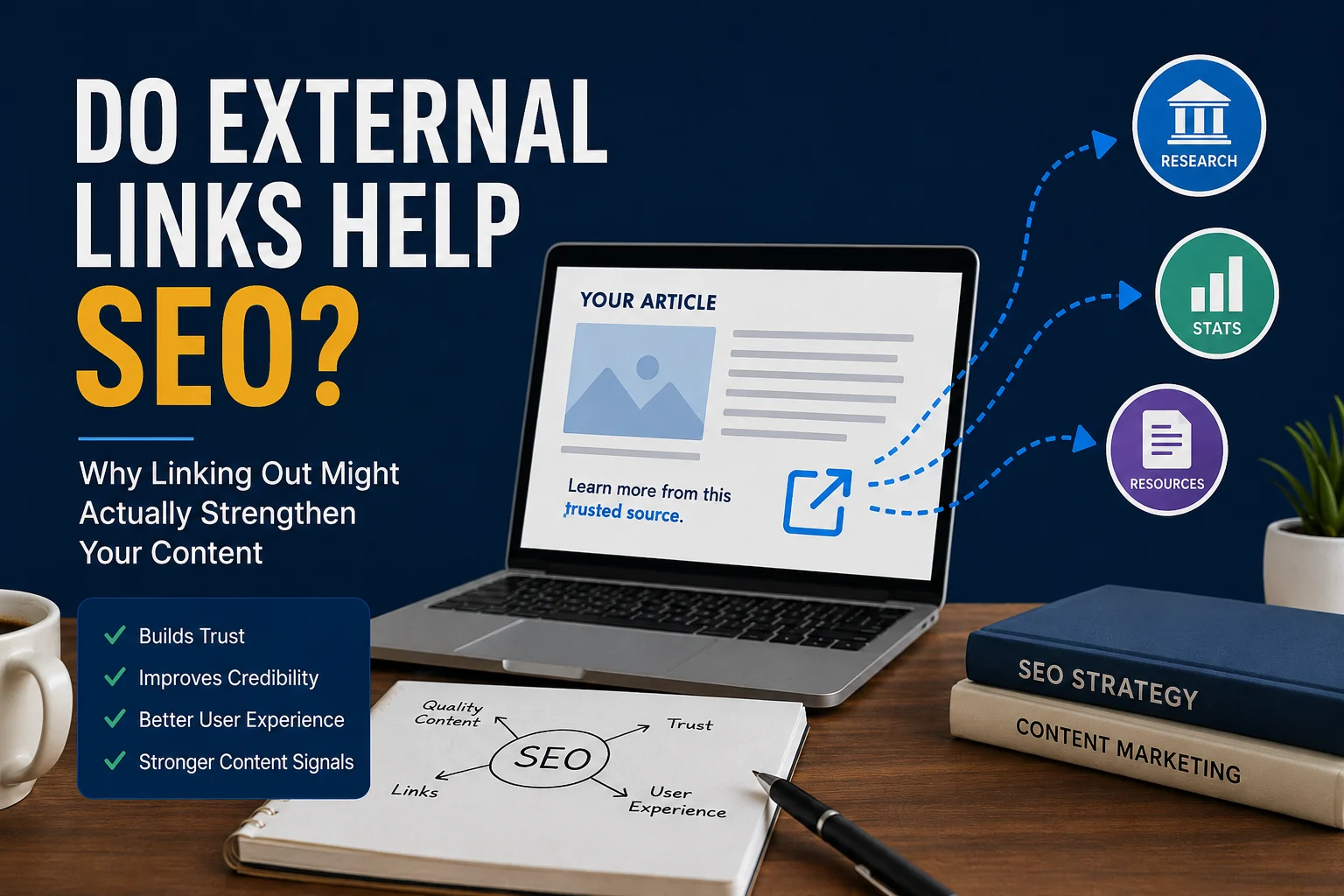
Let’s actually talk about whether do external links help seo is even the right question to be asking.
What External Links Actually Do for Your Page
When you link out to another website, you’re not just being helpful to your readers. You’re sending a signal to search engines about the company your content keeps.
Google’s systems are designed to understand topical relevance and authority. When your article about nutrition links to a peer-reviewed study on PubMed, that says something about the quality of your sourcing. When it links to a random blog with no clear expertise, that says something too.
Think of it like writing an academic paper. A well-cited piece feels more credible than one that references nothing. Search engines have been moving in this direction for years, and the logic holds up.
So yes, external links can help SEO, but the quality and context of those links matter far more than the quantity.
The Biggest Myth: Linking Out Hurts Your Rankings
This is probably the most repeated and most misunderstood idea in SEO.
The “PageRank sculpting” thinking was more relevant back in the early 2000s. The idea was that every link out diluted the “link juice” flowing through your page. So some people started using rel="nofollow" on everything, or just avoiding outbound links altogether.
That era is long gone. Modern ranking systems don’t work the way a simple bucket-of-juice model suggests. Google has confirmed multiple times that linking to high-quality external resources is a good practice, not a liability.
John Mueller from Google said it pretty clearly back in 2020: external links to relevant, authoritative sites are part of what makes a page useful. That’s the standard they’re trying to reward.
When External Links Actually Improve Your SEO
There are a few specific ways that linking out can work in your favor.
Building topical trust: If you’re writing about a medical topic and you cite sources like the Mayo Clinic or WHO, you’re placing your content in a trusted neighborhood. That context signals quality.
Supporting your claims: An article that backs up statistics with real sources is harder to dismiss than one making unsupported claims. This matters for E-E-A-T, which is Google’s framework for evaluating content quality across expertise, experience, authority, and trustworthiness.
Improving user experience: When someone reads your post and finds genuinely useful links to learn more, they spend more time engaging with your content ecosystem. That behavior sends positive signals.
Getting noticed by other sites: Linking to other creators sometimes opens doors. People notice when someone references their work, and that goodwill occasionally turns into a backlink your way.
You can read more about how Google evaluates content quality in Google’s Search Essentials documentation, which covers the principles behind what they actually reward.
The Mistakes That Make Outbound Links Hurt You
Not all external linking is good, obviously. Here’s where things go wrong.
Linking to low-quality or spammy sites is the most obvious one. If you’re writing about personal finance and you link to a site that’s basically a scam or has zero editorial standards, that’s a problem.
Linking out in bulk without purpose. Some people add a dozen external links thinking more citations equals more credibility. It doesn’t. Each link should serve a clear reason for being there.
Broken outbound links. A link that goes nowhere is worse than no link at all. Run a basic audit every few months to make sure the sites you’re pointing to still exist and are still relevant.
Over-relying on nofollow. If you nofollow every single external link, you’re basically saying you don’t trust any source you cite. That’s a weird signal to send, and it removes the benefit of associating your content with authoritative sources.
A useful free tool for checking your outbound links and overall page health is Ahrefs Webmaster Tools, which has a solid free tier.
A Real-World Example Worth Thinking About
Imagine two articles about “how to treat a sprained ankle.”
Article A has no outbound links. It makes claims, gives advice, and ends there.
Article B links to a sports medicine journal explaining the RICE method, and to a physio association explaining when to see a doctor.
Which one do you trust more as a reader? Which one do you think Google is more likely to consider a genuinely helpful resource?
Article B isn’t leaking value. It’s demonstrating that the author actually knows the space and cares enough to point people toward the right information.
That’s the mindset shift that makes external linking useful rather than scary.
Practical Guidelines for Linking Out Well
A few things worth following if you want external links to work for you rather than against you:
- Link to primary sources when possible: research papers, official documentation, government sites, recognized industry organizations
- Use anchor text that makes sense in context, not just “click here”
- Avoid linking to competitors on your most competitive pages, though this matters less than people think
- Check your outbound links periodically for 404s or redirects that lead somewhere weird
- Don’t link out just to seem authoritative, link because the source adds something your content doesn’t
Final Thought
The question of whether do external links help SEO is really a question about what kind of content you’re building. If you’re writing content designed to genuinely help people understand something, external links are a natural part of that. They reflect how knowledge actually works.
Search engines are increasingly good at recognizing this. The pages that try to hoard authority by linking to nothing often end up feeling thin and disconnected. The ones that engage with the wider web tend to feel more real.
Link out when it makes sense. Link well. That’s the whole thing.