
What Is Quantum Efficiency and Why Does It Matter More Than You Think?
Here’s something most people never think about: every time your phone camera takes a photo, every time a solar panel soaks up the afternoon sun, there’s a hidden number doing a lot of the heavy lifting. That number is quantum efficiency, and it quietly determines how good, how fast, or how powerful a device actually is.
It’s one of those terms that sounds intimidating but makes a lot of sense once you strip away the jargon.
The Simplest Way to Understand It
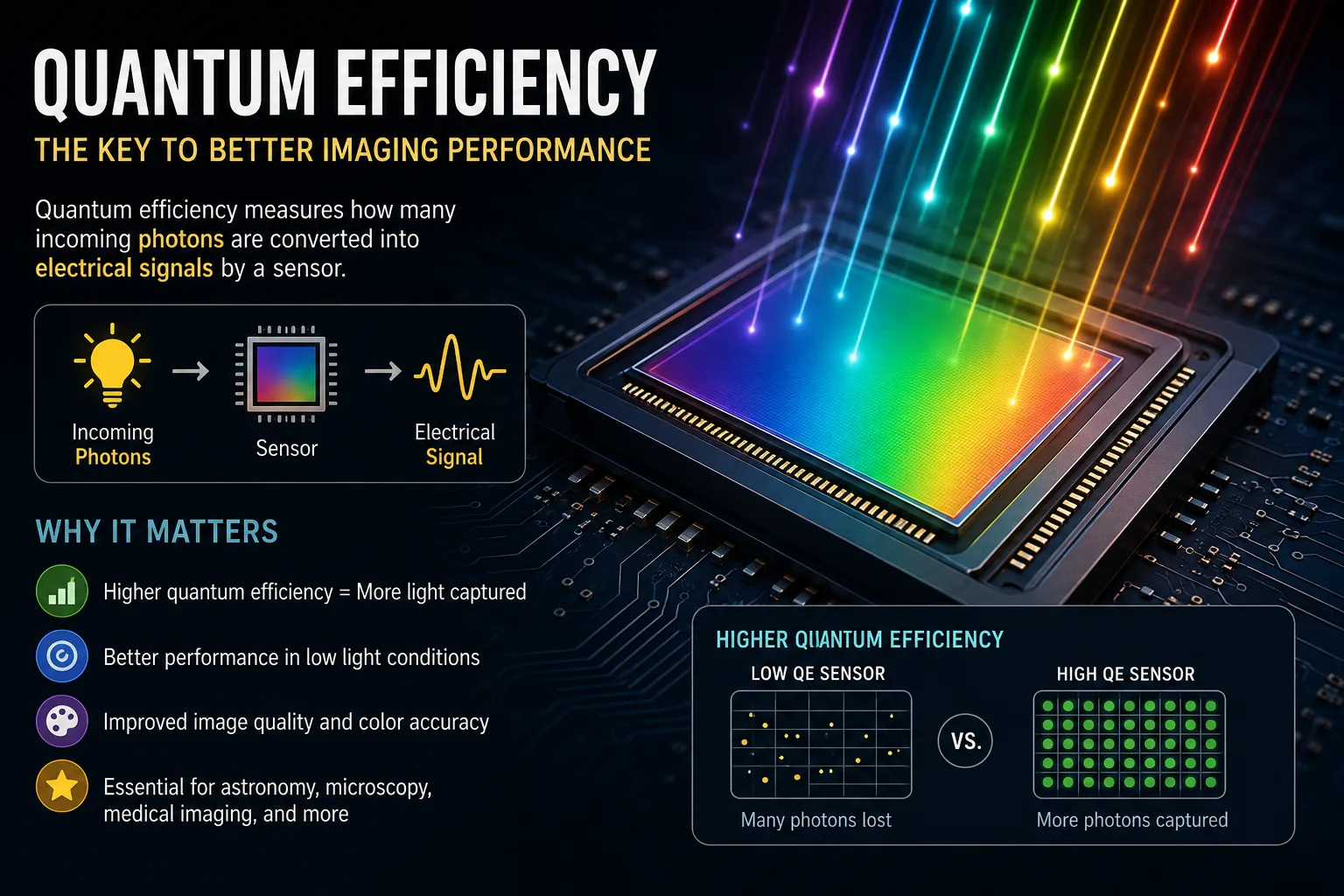
At its core, quantum efficiency measures how well a system converts incoming photons (light particles) into a useful output, whether that’s electrical current, a digital signal, or usable energy.
Think of it like this: if 100 photons hit a solar cell and only 80 of them produce electrons that contribute to electricity, the device is operating at 80% quantum efficiency. The other 20 just didn’t do anything useful. They bounced off, got absorbed as heat, or simply passed through.
Higher is better. Always.
The closer you get to 100%, the more you’re squeezing out of the light you’re given. In fields like solar energy, medical imaging, and astronomy, that difference between 60% and 90% efficiency isn’t just academic. It’s money, accuracy, and performance.
Where Quantum Efficiency Actually Shows Up
You’d be surprised how many everyday technologies depend on this concept.
Solar panels are the obvious one. Researchers spend enormous effort pushing solar cell efficiency higher because even a few percentage points of improvement can change the economics of renewable energy at scale.
Digital cameras and scientific sensors rely on a component called a charge-coupled device (CCD) or CMOS sensor. The quantum efficiency of that sensor determines how well it captures low-light scenes. A high-efficiency sensor can grab a sharp image in dim conditions where a lower-efficiency one would produce noise and blur.
Medical imaging is another area where it matters enormously. In PET scans, X-ray detectors, and fluorescence microscopes, quantum efficiency determines how much signal the machine can actually use versus what gets lost. In diagnostics, losing signal means losing detail. That can have real consequences.
And in fiber optic communications, photodetectors convert light signals into electrical ones. The efficiency of that conversion affects the speed and clarity of data transmission.
So it’s not just a physics concept sitting in a textbook. It’s baked into the devices you use and the infrastructure around you.
Why Getting It Wrong Is Costly
Here’s where things get interesting for anyone designing or evaluating systems.
Overestimating quantum efficiency during design is a common and expensive mistake. Engineers working on imaging systems sometimes assume near-ideal efficiency in their calculations, then run into real-world performance that falls short. The result? A product that underperforms, or a system that needs expensive recalibration.
On the manufacturing side, inconsistencies in how a device is fabricated can cause efficiency to vary across a batch of sensors or panels. Two products that look identical on paper can behave quite differently in the field.
There’s also the issue of wavelength dependence. Quantum efficiency isn’t a single flat number for most devices. It changes depending on the wavelength of light. A sensor might be highly efficient at green light but much weaker at infrared. Ignoring this when you’re choosing components for a specific application is a mistake that only shows up later, usually at the worst possible moment.
The Gap Between Theory and Reality
This is worth paying attention to, especially if you work in research or product development.
Theoretical quantum efficiency calculations often assume ideal conditions: perfect absorption, no surface defects, no reflection losses, no recombination of electrons before they can be collected. Reality is a lot messier.
Surface passivation is a technique used in solar cells and sensors to reduce the number of defects that cause efficiency losses. It’s one of the main reasons modern commercial solar panels perform much better than those from 15 years ago. The physics hasn’t changed. The engineering has just gotten much better at closing the gap between what’s theoretically possible and what’s practically achievable.
Anti-reflective coatings are another example. A bare silicon surface reflects a significant portion of incoming light before it even has a chance to contribute anything. Add a coating tuned to the right wavelength, and you recover a chunk of that lost efficiency without changing anything about the underlying device.
Small improvements, stacked together, add up.
How to Think About Quantum Efficiency When Evaluating Products
If you’re ever comparing solar panels, cameras, or scientific instruments, quantum efficiency data is one of the most honest performance metrics available. It doesn’t care about marketing. It tells you directly how the device handles real light input.
A few things worth looking for:
- Spectral response curves show efficiency across different wavelengths. If your application involves a specific light source, check whether the device is efficient in that range.
- Internal vs. external quantum efficiency is a distinction worth understanding. External quantum efficiency accounts for reflection losses; internal does not. When comparing specs across products, make sure you’re comparing the same metric.
- Operating temperature can affect efficiency in some materials. For outdoor solar applications especially, check how the device behaves as it warms up.
None of this requires a physics degree to apply. It just requires asking the right questions before making a decision.
A Quiet Metric With a Big Job
Quantum efficiency doesn’t get headlines. It’s not the kind of number that ends up in advertising copy. But it’s doing real work in the background of some of the most important technologies of our time.
Whether you’re thinking about renewable energy, medical diagnostics, space observation, or everyday photography, understanding even the basics of how efficiently a device uses light gives you a much clearer picture of what you’re actually dealing with.
The next time someone tells you a solar panel or sensor is high performance, it’s a fair question to ask: high performance at what, exactly? Quantum efficiency might just be the answer they’re not mentioning.