
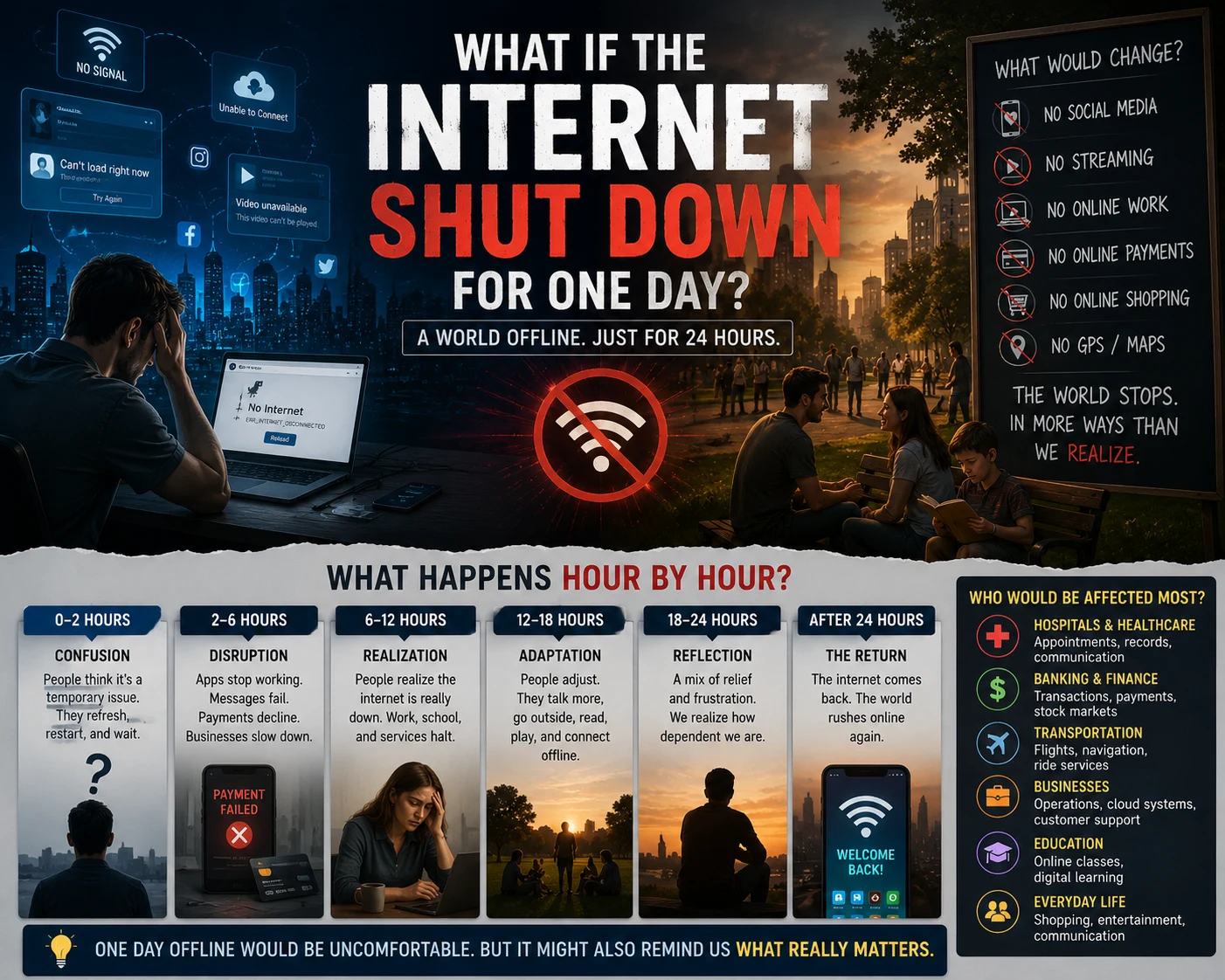
Picture this. You wake up tomorrow and your phone just shows a spinning circle. Wi-Fi is on, bars are full, but nothing loads. You try a different app. Nothing. You check the news on your laptop. Nothing loads there either.
At first, it feels like an outage. You restart the router. You restart your phone. Then your neighbor knocks on your door asking if yours is down too. Then you start to understand.
The internet is just… off.
The First Hour Would Be Disorienting in Ways You Do Not Expect
Most people underestimate how much mental energy they spend on passive internet use throughout a day. Quick checks. Background music. Looking something up mid-conversation. Sending a photo.
That first hour without it would feel oddly loud inside your own head.
Then the practical problems would start stacking up. Card payments depend on internet connections. ATMs run on networked systems. Your navigation app is gone. If you have a smart home setup, half of it stops responding. That “offline” version of the world you assume exists in the background? It is thinner than most people realize.
What Would Actually Break
This is where the situation stops being a thought experiment and gets genuinely serious.
Hospitals would be under immediate pressure. Modern medical facilities run on connected systems for patient records, lab results, prescription management, and internal communications. Most have backup protocols, but a full global outage would stress those systems hard.
Supply chains would freeze within hours. Shipping logistics, port operations, air traffic control communication systems, warehouse inventory management, all of it relies on real-time data flowing across networks. Trucks would still drive, but the coordination that tells them where to go and what to pick up would collapse.
Financial markets would halt. Stock exchanges would stop trading. International transfers would fail. Businesses that operate on thin margins and depend on daily cash flow would start feeling it by end of day. According to CloudZero’s research on internet outage costs, a single 24-hour outage in the US alone would result in losses running into the tens of billions of dollars.
Even the power grid in many places depends on internet-connected monitoring and load-balancing systems. A full internet shutdown would not automatically cut the lights, but it would make the lights significantly harder to manage.
The Human Behavior Part Is Fascinating
Here is what would actually be interesting to watch. How people fill the silence.
Within a few hours, people would start talking to each other more. Not in a wholesome viral-video way, but out of pure necessity. You need information and there is no other way to get it. So you ask the person next to you.
Local radio stations would suddenly become the most important communication channel in most cities. People who own transistor radios would become surprisingly popular. Libraries would fill up.
And the weird thing? A lot of people would probably feel a quiet relief mixed in with the stress. That low-grade anxiety of notifications and feeds and news cycles, just gone for a day. Some people would hate it. Others would breathe in a way they have not for years.
What Would Not Break (And This Part Matters)
A lot of deeply human things are not internet-dependent at all.
Books still work. Conversations still work. Board games, card games, cooking from memory, walking somewhere without a map, paying in cash, listening to the radio. Community noticeboards. Libraries. Neighbors.
It is almost funny how quickly “what would we do without the internet” turns into a list of things that existed for most of human history and worked just fine.
This is not a romanticized argument for going offline. The internet genuinely enables things that were not possible before, including some of the most unexpected ones, like the strangest and most specific online communities people have built around the smallest shared interests. That kind of connection is real and it matters.
But a one-day shutdown would be a very sharp reminder of how much infrastructure we have quietly outsourced to a system most of us do not understand and almost none of us could rebuild.
The Day After Would Change Things
One day of internet shutdown would likely produce more serious conversations about digital infrastructure than a decade of policy papers.
Every company that discovered a critical weakness in its backup systems would quietly fix it. Every hospital that realized its offline protocols were outdated would update them. Governments would push for decentralized backup networks with far more urgency.
There would also, almost certainly, be a wave of people who decided to deliberately keep some of their reclaimed habits. More phone calls. More physical books. More cash in the wallet.
The internet shutting down for one day would not break civilization. It would, however, hold up a mirror and show exactly how dependent on one fragile system most of modern life has quietly become.
A Thought Worth Sitting With
The internet was never supposed to be critical infrastructure. It started as a research network and became the backbone of nearly everything without any single moment where someone made that choice deliberately.
That is worth thinking about more than we do.
If your entire morning routine depends on a network you do not control, if your income depends on platforms you do not own, if your social life depends on apps that could disappear, what does your backup look like?
One offline day would not kill anyone with a plan. The real question is how many of us have one.