
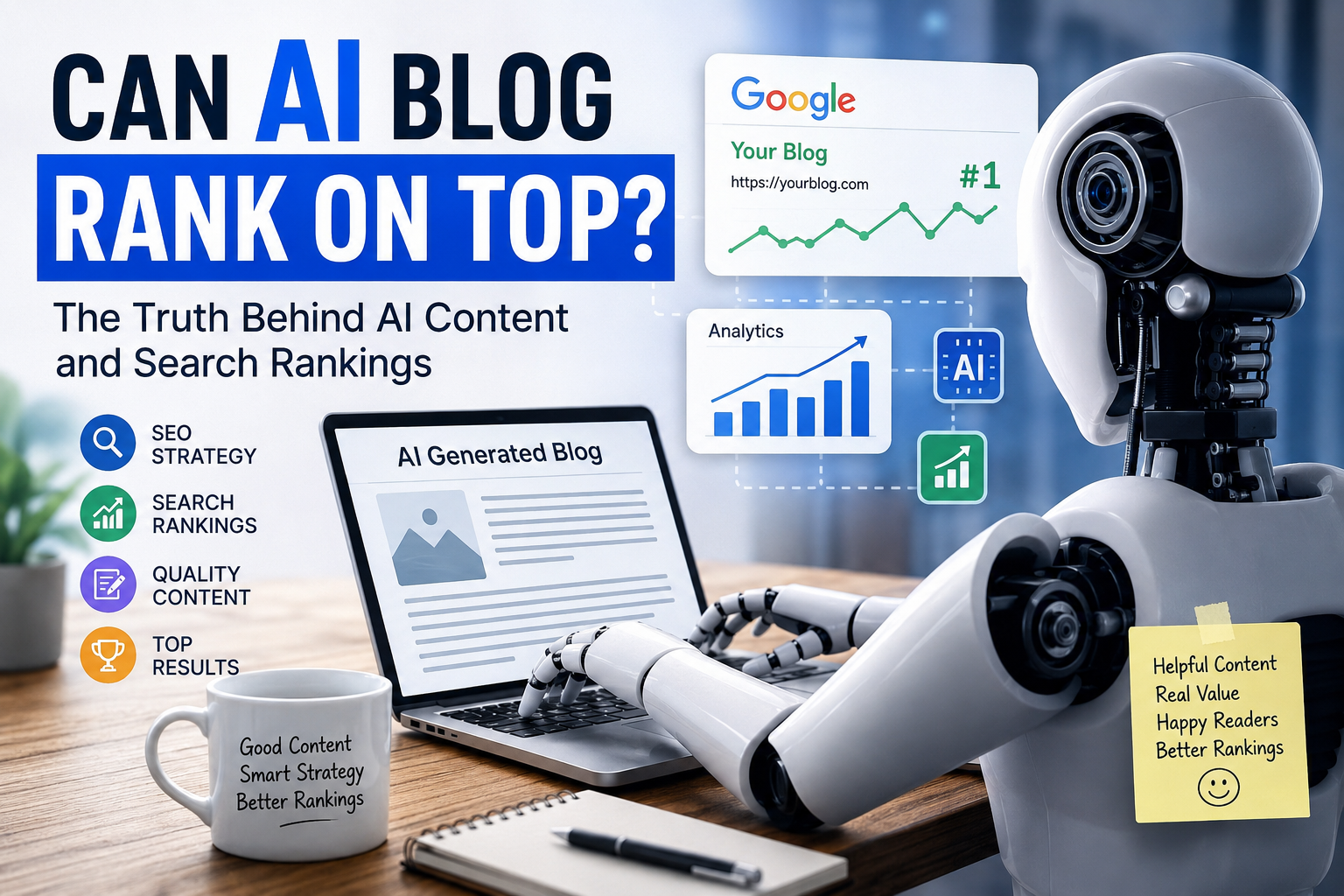
Ever noticed how some AI-written articles pop up on Google and make you wonder, “Wait… how is this ranking?”It feels a bit strange at first, like the rules of content just changed overnight. But here’s the real question people keep asking: Can AI blog rank on top?And the answer is not as simple as yes or no, it depends on a few things most people ignore. Why people think AI blogs can rank easily There’s this belief floating around that AI content can dominate search because it’s fast and cheap to produce. And honestly, that part is true. AI can: Generate hundreds of posts quickly Cover keywords at scale Structure articles neatly Produce “good enough” readability So naturally, people assume Can AI blog rank on top? must have a yes answer. But speed alone doesn’t win SEO anymore. What actually helps AI content rank Search engines don’t really care who wrote the content. They care about signals. Some of the real ranking factors: Does the content solve a real problem? Is it more helpful than competing pages? Are people staying on the page or bouncing away? Does it feel trustworthy or shallow? I’ve seen AI-written posts rank when they are: Edited by humans Based on real experience or data Targeted to very specific search intent So again, Can AI blog rank on top? Yes, but only when it stops acting like “just AI content” and starts behaving like useful content. This raises a deeper question that connects closely with broader societal change: What Will Humans Do When Everything Becomes Automated? Where AI blogs usually struggle This is where things get interesting. AI content often fails in subtle ways: It sounds too smooth but says very little It lacks real opinions or lived experience It repeats common internet ideas It misses emotional or practical depth Search engines are getting better at detecting low-value patterns. Even Moz has discussed how thin or generic content struggles over time when compared to experience-driven writing: Moz SEO Learning Resources And I’ve seen this happen firsthand. A blog ranks for a short time, gets some traffic, then slowly disappears. Not because it was “wrong,” but because it wasn’t memorable or useful enough to stay. A real-life scenario that explains it better Imagine two blogs about learning SEO. One is AI-written, clean, structured, covers everything. The other is written by someone who actually tried ranking a website, failed a few times, adjusted content, and shared what changed. Guess which one people trust more? Even if both answer the question, only one feels “real.” And that’s where ranking power quietly shifts. So when people ask Can AI blog rank on top?, they’re really asking something deeper: can content without experience still compete? Sometimes yes, but it needs human input somewhere in the chain. What actually works if you’re using AI for content If you’re planning to use AI for blogging, here’s what makes a difference: Add personal insights or testing results Rewrite sections in your own voice Focus on one clear audience, not everyone Don’t publish raw output without editing Include real examples or observations Search engines are less interested in “who wrote it” and more in “does this help anyone?” So, is AI content the future of blogging? It probably is part of it, not the whole thing. AI makes content creation easier, but ranking still depends on depth, usefulness, and trust. And that brings us back to the same question people keep circling around: Can AI blog rank on top? It can, but only when it stops trying to replace human thinking and starts working with it. Sometimes the tool isn’t the issue, it’s how it’s used.
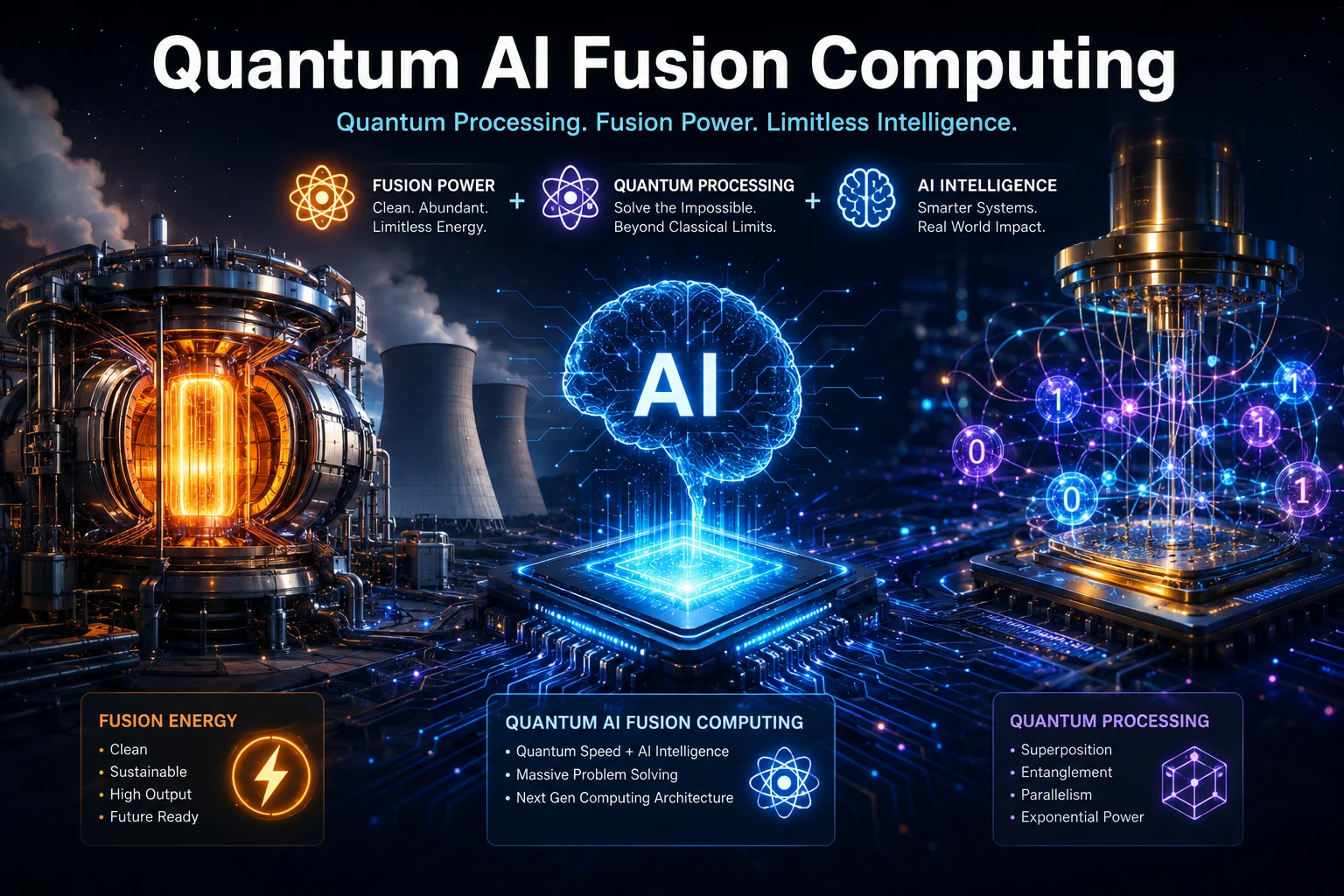
Quantum AI Fusion Computing: Energy and Intelligence Start Blending
Have you ever looked at how fast AI is growing and thought, where does this actually end? Now imagine mixing that with quantum processing and fusion power. That is where things start feeling less like tech news and more like science fiction that is slowly becoming uncomfortable real. The idea of quantum AI fusion computing sounds almost made up, but it is the kind of concept people in advanced research circles quietly explore. Not because it is fully here yet, but because it might reshape everything if it ever works at scale. This raises a deeper question that connects closely with broader societal change: What Will Humans Do When Everything Becomes Automated? The strange overlap of AI, quantum processing, and fusion energy Most people think of AI as software and quantum computing as futuristic hardware. Fusion power sits in a completely different lane as an energy dream that could replace traditional grids. But what happens when these three collide? AI needs massive energy and compute power Quantum systems promise new types of computation Fusion power could theoretically supply near-limitless clean energy Put together, quantum AI fusion computing becomes a thought experiment about what happens when intelligence is no longer limited by energy scarcity or classical processing limits. It is not about what exists today. It is about what becomes possible if constraints disappear. And that leads directly into a more uncomfortable layer of the discussion: Are We Teaching Machines to Be Intelligent or to be Us? Why people are even talking about this idea Honestly, a few years ago this would have sounded like pure fantasy. But now, each piece is slowly becoming real in isolation. Quantum research is progressing, AI models are getting heavier, and fusion projects are no longer just lab dreams. A relatable way to think about it is this: Imagine running a simulation so large that it normally crashes your computer. Now imagine a system where compute power and energy are no longer the bottleneck. That is the direction this conversation is pointing toward. This is where the term quantum AI fusion computing starts getting used as a kind of shorthand for “post-limitation computing.” The practical confusion most people have Here is where things get messy. A lot of people assume this means we will soon have super smart AI running on quantum fusion super machines. That is not how it works. Some common misunderstandings: Quantum computers are not just faster AI chips Fusion energy is not plug and play electricity yet AI cannot simply “plug into quantum systems” and level up The overlap is mostly theoretical and experimental at this stage. Still, it is easy to see why the phrase spreads. It sounds like the next logical step, even if reality is far more fragmented. A real world way to picture it Let us ground this a bit. Think about a weather simulation system trying to predict global climate patterns. Today, even supercomputers simplify a lot. Now imagine: AI helping interpret patterns in real time Quantum systems handling complex probability models Fusion power removing energy constraints for large scale simulations That is a simple mental picture of what quantum AI fusion computing might eventually support. Not a product. More like an extreme capability scenario. The uncomfortable question nobody agrees on If systems like this ever become possible, the question is not just technical. It becomes philosophical. Do we actually want intelligence systems that are not limited by energy or traditional computing boundaries? And who controls something that powerful? It is one thing to talk about innovation. It is another to think about scale without limits. Closing thought Right now, quantum AI fusion computing sits in that blurry space between research, imagination, and long term speculation. But it is interesting because each part of it is slowly becoming less imaginary on its own. Maybe the real story is not whether it exists yet, but whether we are ready for what it implies. And that question is still wide open.
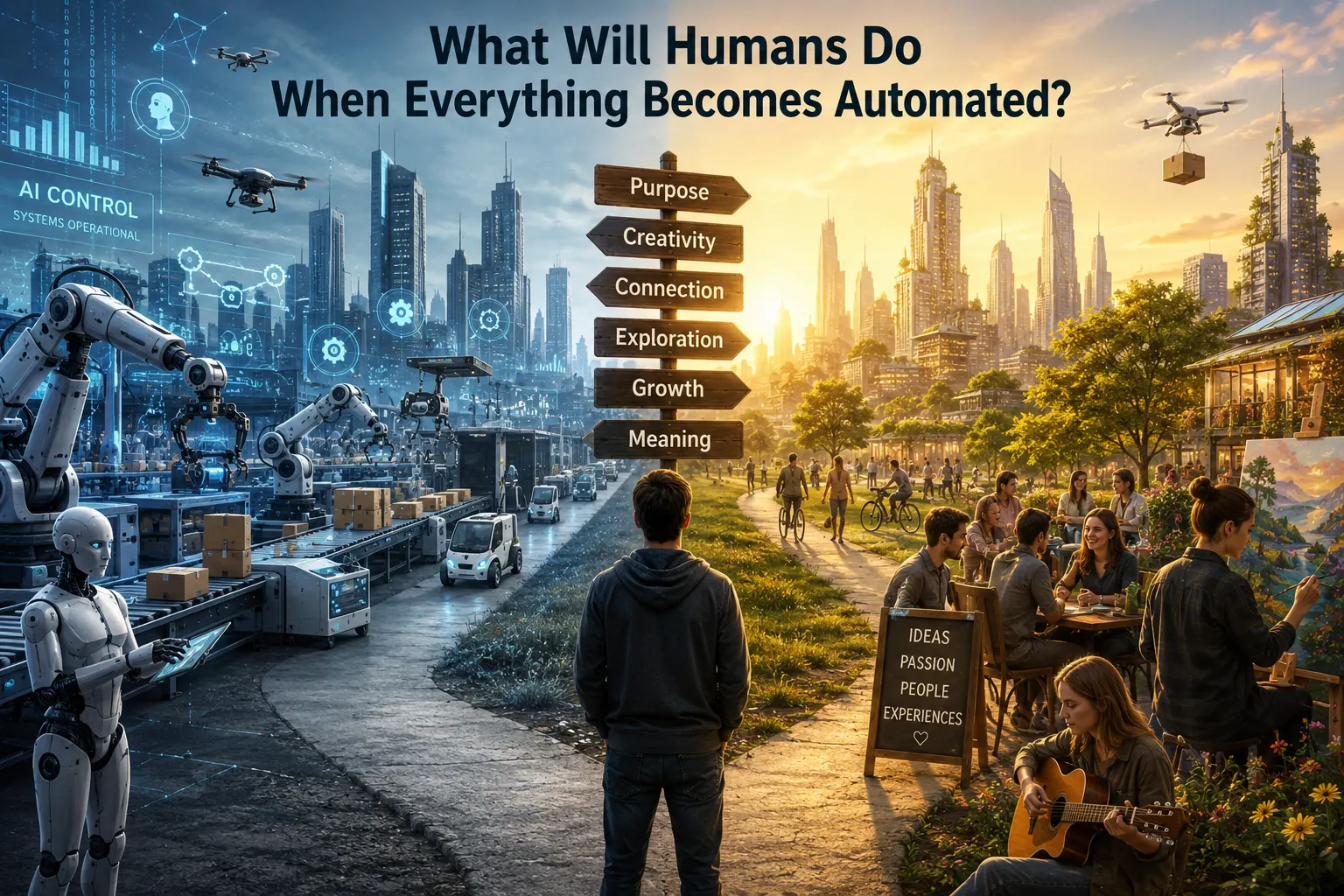
What Will Humans Do When Everything Becomes Automated?
A few years ago, ordering food through an app felt futuristic. Now your phone predicts what you want before you even type it. Cars can park themselves. AI writes emails. Warehouses run with barely any human workers. So it raises a strange question. What happens to people when machines start doing almost everything better, faster, and cheaper? That question sounds dramatic until you notice how normal automation already feels. Most of us barely react to it anymore. And honestly, that might be the biggest shift of all. The Real Fear Is Not Losing Jobs People often talk about automation like it’s only about employment. Truck drivers replaced by self driving systems. Cashiers replaced by kiosks. Writers competing with AI tools. But work is only one part of human identity. A lot of people wake up each day because they feel needed. Their routines give structure to life. Without that sense of contribution, things can get emotionally complicated very quickly. Imagine someone who spent 30 years mastering a skill, only to watch software do it in seconds. That hurts in a way technology discussions rarely mention. Humans May Move Toward More Human Things Here’s the interesting part though. Every time machines take over repetitive tasks, humans usually shift toward things that feel more personal. Not perfect. Not efficient. Human. We already see it happening: Handmade products are valued more than factory items People pay extra for human customer support Live experiences matter more in a digital world Authentic storytelling beats polished corporate content Maybe the future becomes less about productivity and more about meaning. That sounds idealistic, but maybe automation pushes us there naturally. A World Full of Free Time Sounds Great, Until It Isn’t Most people dream about having more free time. Then they get a long vacation and feel restless after three days. Humans are not very good at doing nothing. If automation removes most labor, society could face a strange emotional problem. People may struggle with direction more than survival. You can already see hints of this online. Endless scrolling. Constant distraction. People searching for purpose in productivity apps and side hustles. When Everything Becomes Automated? the biggest shortage might not be money. It could be meaning. The New Status Symbol Could Become Creativity In the past, physical labor had value. Then knowledge work became powerful. Now AI is starting to handle parts of both. So what becomes valuable next? Possibly original thinking. Not because machines cannot generate content, they clearly can. But because humans still connect deeply with lived experience, emotion, and perspective. A song written after heartbreak hits differently when you know a real person felt it. A story told by someone who struggled feels more alive than perfectly optimized content. People may stop asking, “Was this made efficiently?” They may ask, “Was this real?” The Automation Gap Could Divide Society Not everyone will experience automation the same way. Some people will use AI tools to build businesses, save time, and gain freedom. Others may feel left behind very quickly. That gap could become one of the biggest social challenges of the next decade. Think about older workers trying to adapt to tools changing every few months. Or younger generations growing up in a world where basic skills are outsourced to software. There’s also a risk that convenience slowly weakens curiosity. If AI answers everything instantly, do people stop exploring deeply on their own? That possibility feels more concerning than robots taking over factories. A Small Real Life Example Last month, a friend told me he no longer writes his own emails. AI drafts them. His calendar organizes itself. Even meeting notes are summarized automatically. At first he loved it. Then he admitted something strange. He felt less mentally present during the day because fewer things required real attention. That stuck with me. Convenience saves effort, but effort is often where engagement comes from. Maybe Humans Become More Selective The future probably will not turn humans into lazy spectators sitting around while robots do everything. More likely, people become more selective about where they spend energy. Machines may handle repetition. Humans may focus on: Relationships Creativity Experiences Personal growth Exploration Emotional connection At least, that’s the hopeful version. The Future Might Feel Emotionally Different Most conversations about automation focus on economics and technology. But I think the emotional side matters just as much. When Everything Becomes Automated? people may spend less time asking how to survive, and more time asking why they exist, what matters, and what actually feels fulfilling. That sounds philosophical, but maybe automation forces humanity into that conversation whether we want it or not. And honestly, we are probably less prepared for that question than we think.
Are We Teaching Machines to Be Intelligent or to be Us?
Every time a chatbot gives you a surprisingly thoughtful answer, there’s a temptation to say, “Wow, it actually understands.” But does it? Or did we just teach it to sound like someone who does? That question sounds philosophical at first. But the more AI shows up in real life, the more practical it becomes. Because what we’re really asking is: when we build these systems, what exactly are we building toward? The Difference Between Learning and Mimicking Here’s a simple scenario. You show a child a thousand pictures of dogs. They eventually learn what makes a dog a dog, not just the ears or the fur, but something more general. They can spot a dog in a cartoon, a shadow, or a blurry photo. AI systems do something similar, but the process underneath is very different. They find statistical patterns. They learn what pixels or words tend to appear together. It works remarkably well. But is that the same as understanding? The honest answer is: we don’t fully know. And that uncertainty is at the center of everything happening in AI right now. When researchers talk about machine intelligence, they often split into two camps. One side says intelligence is about behavior. If a machine does intelligent things, it is intelligent. The other side says behavior isn’t enough. There has to be something going on inside, some form of reasoning or awareness, not just pattern-matching at scale. Neither side has fully convinced the other. What We Actually Feed These Systems To train a large language model, you need text. Lots of it. Books, articles, websites, forums, code, conversation transcripts. Basically, the written output of human thought over decades. So when the model learns to write, argue, explain, or joke, it’s learned from us. It studied how we structure sentences when we’re confused. How we hedge when we’re not sure. How we get enthusiastic when something excites us. That’s not intelligence in the abstract. That’s a reflection of human intelligence specifically. Which raises a strange question. If a machine gets good at being human, is it becoming intelligent, or is it just becoming a very good impersonation of us? It can explain photosynthesis, but it learned that from biology teachers who wrote it down. It can write poetry, but it learned meter and metaphor from poets who came before. It can give advice, but it learned that from advice columns, self-help books, and therapy transcripts. Every output traces back to a human original. That doesn’t make it worthless. But it does make the word “intelligent” worth examining more carefully. The Mirror Problem There’s something called the mirror problem in AI. Not an official term, just a useful way to think about it. When you talk to an AI and it responds in a way that feels warm or clever, you’re partly reacting to yourself. The system learned from humans. It’s giving you back something shaped by human expression. So of course it feels familiar. Of course it feels intelligent. You’re essentially talking to a very complex echo. That’s not a criticism. Echoes can be useful. They can be beautiful, even. But mistaking an echo for a voice is a different thing entirely. This matters practically. If we design AI systems around the assumption that they think the way we do, we’ll be surprised when they fail in ways no human would. They don’t get tired and make careless errors for the same reason we do. They don’t feel social pressure to double-check their work. They don’t have a gut feeling that something is off. They approximate all of those things. But approximation and the real thing behave differently at the edges. Where It Gets Interesting: When Machines Surprise Us Here’s where I’ll push back on my own argument a little. Sometimes AI systems do things nobody explicitly taught them. They find solutions to math problems using steps researchers hadn’t considered. They identify patterns in protein structures that took scientists years to notice. In certain narrow domains, they seem to go beyond what was modeled in their training data. Is that intelligence? Or is it just very fast, very thorough pattern recognition working at a scale humans can’t match? Honestly, it might be both. Or the line between those two things might not be as clear as we assumed. The uncomfortable possibility is that what we call intelligence has always been, in part, sophisticated pattern recognition. We just run it on biological hardware with emotions, memory, embodied experience, and motivation. Maybe the machines are doing something genuinely similar, just without most of those layers. Or maybe those layers are what make intelligence real, and without them, it’s something else entirely. Why It Matters More Than It Seems If we’re teaching machines to be us, then AI reflects our values, our biases, our blind spots, and our gaps. That’s already happening. AI systems trained on human data have reproduced racial bias, gender stereotypes, and cultural assumptions embedded in that data. We didn’t program that in. It arrived with the training. Because we trained on ourselves. That means the question of whether we’re building machine intelligence or a mirror of human intelligence isn’t just philosophical. It’s a design question. A safety question. An ethics question. If it’s a mirror, we need to think hard about what we’re reflecting. And whether we want those reflections making decisions, writing diagnoses, or shaping what people read and believe. So, What Are We Actually Building? My take, for what it’s worth: we’re doing both at once, and we haven’t fully separated the two. We’re building systems that can do things no single human could do, processing millions of documents, generating code in seconds, spotting signals in massive datasets. That part feels new. But we’re building those systems almost entirely from human-generated material, shaped by human feedback, evaluated by human standards of what a good answer looks like. We’re not building an alien intelligence. We’re building an amplified, accelerated version of our own collective thinking. Which is genuinely

When AI Learns From Us, What Exactly Is It Learning About Humanity?
Here is a strange thought to sit with: every time you search for something embarrassing at 2am, argue with a stranger online, or type and then delete a message, you are leaving a trace. And AI systems are built on billions of those traces. Not just the polished, public-facing stuff either. The rants. The regrets. The weird late-night rabbit holes. The unfiltered version of human thought that most people would never say out loud in a room full of people. So when we talk about AI learning from human data, the real question is not just “how does it work?” It is more uncomfortable than that. What does all of that data say about us? We Did Not Feed AI Our Best Selves There is a fantasy version of this story where humanity uploads its greatest achievements, its poetry and science and philosophy, and AI emerges wise and noble because of it. That is not quite what happened. AI systems are trained on the internet, on digitized books, on forums and comment sections and product reviews and social media posts. And anyone who has spent time in those spaces knows: human beings online are not always operating at their finest. And it goes deeper than social media. Even tools people use for privacy, like free VPN apps, are often quietly collecting browsing habits and behavioral data, and that kind of silent harvesting is part of the broader pipeline that feeds AI systems far more personal information than most users ever realize. We express fear more easily than gratitude. We argue in bad faith. We repeat misinformation because it confirms what we already wanted to believe. We are funnier at 11pm and meaner when we feel anonymous. AI learned from all of that. Not just the Wikipedia entries. The whole mess. The Patterns AI Finds Are Deeply Human Ones When researchers examine what large language models actually pick up, the patterns are revealing in ways that go beyond grammar or vocabulary. AI learns that humans return to the same fears over and over. Illness, financial ruin, loneliness, irrelevance. These themes appear across cultures and centuries of text. They are not quirks of the internet age. They are just more visible now. AI learns that we are inconsistent. People say they value honesty and then lie constantly in small, face-saving ways. People say they want information and then scroll past it to find something that already agrees with them. This inconsistency is baked into the data. The model learns that humans do not behave the way they claim to. AI also learns the shape of human curiosity. How we ask questions. What we search for when no one is watching. What topics make us circle back again and again. And that curiosity, honestly, is one of the more flattering things the data reveals. Our Biases Travel With the Data One of the harder truths about AI learning from human-generated content is that it does not just learn the information. It learns the biases embedded in that information. Historical text reflects who had access to literacy and publishing. Online text reflects who had access to the internet and whose voices got amplified. Neither of those populations represents all of humanity equally. So when AI learns “what humans think” about a doctor, a criminal, a leader, a scientist, it is learning what a specific, skewed subset of humans wrote down across a specific window of time. Those learned associations then get baked into outputs. This is not a small technical problem waiting to be patched. It is a reflection of real inequality in whose voices got recorded and whose did not. The data problem is a human problem wearing a technology costume. AI Is Learning Our Language, But Does It Understand Our Experience? Here is where things get philosophically interesting. AI can produce writing that sounds emotionally resonant. It can describe grief in ways that feel true. It can joke, console, challenge, and explain. But it learned all of that by pattern-matching on human expression, not by living any of it. Think about what that means. A model has read thousands of accounts of heartbreak. It has processed the metaphors people reach for, the specific way grief moves through a sentence. And it can generate text that mirrors those patterns well enough to feel real. But it has never waited for a message that did not come. It has never felt the specific weight of a Sunday afternoon after a breakup. There is a gap between learning the language of human experience and having it. AI sits right at the edge of that gap, producing outputs that sometimes close the distance in surprising ways, and sometimes expose how wide it still is. What This Means for Us Going Forward Here is the part that does not get talked about enough. If AI is learning from human data at scale, and AI is increasingly shaping the content we consume, the responses we get, the information we trust, then we are entering a feedback loop. AI learns from us. We interact with AI. AI influences how we think and write and communicate. That new behavior becomes more training data. Which means the question of what AI is learning about humanity is not just a past-tense question. It is happening right now, and the direction it goes depends on what we keep producing. If our data reflects mostly fear, conflict, and misinformation, that is what gets reinforced. If it reflects curiosity, nuance, and genuine attempts to understand difficult things, that feeds something different. This might be the most honest case for caring about what we put into the world, not because of some abstract ethics argument, but because in a very literal sense, what we express collectively becomes the foundation for what AI understands humanity to be. That is a strange kind of responsibility to sit with. But also, maybe, a useful one.

Free VPN, Really Steal Your Data? What Most Users Ignore
You downloaded a free VPN because you wanted privacy. Makes sense, right? But here’s the thing nobody talks about when they recommend those apps: the VPN itself might be doing exactly what you were trying to avoid. Not all of them. But enough that it’s worth paying attention. What Does a Free VPN Actually Cost You? Running VPN servers is not cheap. You need infrastructure, bandwidth, staff, and maintenance. So when an app offers all of that for zero dollars, you have to wonder, what are they getting out of it? The honest answer, in most cases, is your data. Free VPN services have been caught doing things that would shock most users. Some log your browsing activity and sell it to advertisers. Some inject tracking scripts into the pages you visit. A few well-known apps, including ones with millions of downloads, were found sharing user data with third parties, including in some cases, government agencies in countries you probably wouldn’t feel great about. This is not a rare edge case. A study analyzing hundreds of free VPN apps found that a significant portion contained malware or aggressive data collection built right into the app. How the Data Collection Actually Works You open the app, connect to a server, and think your browsing is hidden. But what many free VPNs do is act as a man-in-the-middle between you and the internet. They can see your traffic. And if they log it, it’s no longer private. Some apps sell this data to advertising networks. Others use it to build a profile on you, your habits, your location, what sites you visit. A few have even been discovered using users’ devices as exit nodes, essentially using your internet connection to route other people’s traffic through your IP. One popular free VPN app was found to have routed user bandwidth to a residential proxy network. So you were using it for privacy while your device was quietly doing something else entirely. Signs a Free VPN Might Be Misusing Your Data Not every free VPN is malicious, but there are warning signs worth noticing. Vague or short privacy policies. If a company cannot explain clearly what they log and what they do with it, that’s a red flag. Permissions that don’t make sense. A VPN app asking for access to your contacts or photos is asking for something it has no reason to need. No clear business model. If the app is free, has no paid tier, no premium version, and no obvious way to make money, ask yourself what they’re selling. Based in a high-risk jurisdiction. Some countries have data-sharing agreements or laws that require companies to hand over user data. A VPN registered in one of those regions may not be able to protect you even if they want to. What Anonymous Browsing Actually Requires If you want real anonymous browsing with a VPN, you need a provider that has been independently audited, publishes a transparent no-logs policy, and has a proven track record of not handing over user data when legally pressured. That almost always means a paid service. A genuinely secure VPN will have clear documentation about their infrastructure, their logging policies, and what happens if they receive a government request. Some of the better ones have literally had no data to give when subpoenaed, because they don’t store any. You can find fast VPN options at a reasonable price these days. The difference between a $3 per month plan and a free app is not just speed, it’s trust. The Free Tier Trap Some legitimate VPN companies offer a free tier with limited data or servers. That’s different from an entirely free app with no visible business model. Providers like ProtonVPN offer a free plan that is funded by paid users. They have a clear reason to maintain user trust. That’s a meaningful distinction compared to an anonymous app uploaded to an app store with no company behind it. If you genuinely need a free option, look for one backed by a company with a paid product. At least their reputation is on the line. (For people building online income or remote work setups where privacy matters, VPN usage often overlaps with guides like Freelancing in 2026: How to Start and Get Your First Clients Fast) Is It Ever Safe to Use a Free VPN? For low-stakes use, like accessing a geo-restricted YouTube video at home, some free VPNs are probably fine. The risk scales with what you’re doing. But if you’re using a VPN to protect sensitive activity, work remotely, access financial accounts on public Wi-Fi, or anything where your data actually matters, a free VPN is a gamble you probably shouldn’t take. The irony of it is real. You use a free VPN proxy to hide from one risk and end up handing your data directly to another. Privacy is not free to provide. If someone is providing it for free, it’s worth asking what they’re getting in return.

Best Mileage Tracking Apps for Gig Workers 2026
Stop leaving money on the table! Discover the best mileage tracking apps for gig workers in 2026. Maximize your tax deductions, reduce stress, and keep mor
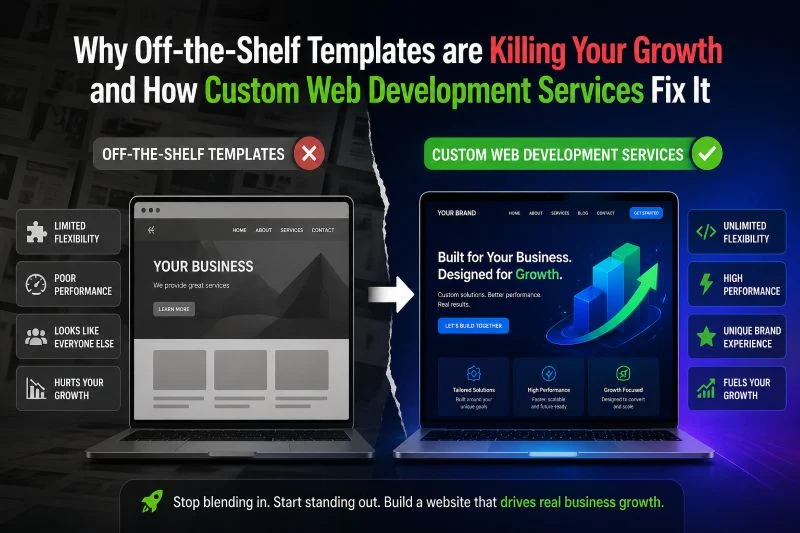
Why Custom Web Development Services Outperform Templates
The Template Trap: Why Your Business Might Need Something More Personal Ever spent hours tweaking a “one size fits all” website theme only to realize it still doesn’t do exactly what you need? It is a frustrating spot to be in. You want a specific button to trigger a unique workflow, or maybe you need your inventory to talk to your CRM in a very specific way, but the template just says no. This is usually the moment business owners start looking into custom web development services. It is not just about having a pretty site. It is about building a tool that actually fits your hands instead of trying to change how you work to fit the software. When “Standard” Just Doesn’t Cut It I remember talking to a friend who ran a boutique logistics firm. He tried every “easy” website builder out there. On the surface, they looked great. But the moment he needed a custom calculator for international shipping rates that factored in real time fuel surcharges, the “easy” builders broke. He was losing hours every day doing manual entries because his website couldn’t handle his specific logic. That is the hidden cost of staying generic. When you invest in a custom web development service, you are essentially buying back your time. You are building a system that follows your rules, not the limitations of a $50 plugin. The Power of Custom Web Application Development Services Sometimes, a simple website isn’t enough. You might need something more robust, like a dashboard for your clients or a private portal for your team. This is where custom web application development services come into play. Think of it like the difference between buying a suit off the rack and getting one tailored. Sure, the rack suit covers you up, but the tailored one makes you feel like a million bucks and allows you to move freely. Security: Custom code is less of a target for automated bot attacks compared to popular platforms. Scalability: You can add features as you grow without worrying about breaking a fragile ecosystem of third-party add-ons. Performance: You only load the code you actually need, which keeps things fast for your users. Does your current site feel like it is holding you back or pushing you forward? Avoiding the Common Pitfalls of Custom Projects If you decide to go custom, don’t just jump at the lowest bid. I have seen too many people get burned by developers who over-promise and under-deliver. The biggest mistake is not having a clear map of what “success” looks like before the first line of code is written. You need a partner who asks about your business goals, not just your favorite colors. A good developer will often tell you “no” to a feature if they think it won’t actually help your bottom line. That honesty is worth its weight in gold. Making the Shift to Custom It can feel like a big leap to move away from the comfort of pre-made templates. The initial cost is higher, and it takes longer to launch. But look at it this way: how much is it costing you to have a website that doesn’t fully represent your brand or automate your boring tasks? In my experience, the businesses that thrive are the ones that own their tech stack. They aren’t at the mercy of a platform’s sudden price hike or a template designer who stops providing updates. Building something unique is an investment in your own digital real estate. It is about creating an experience that your customers will actually remember, rather than another forgettable page in a sea of sameness. If you are tired of fighting with your software, it might be time to see what a dedicated team can build specifically for you. Don’t Forget Where Your Code Lives A great custom site still needs a solid foundation, and that means choosing the right hosting. Many people make the mistake of spending money on a custom build and then putting it on a $5 shared hosting plan. It is like putting a Ferrari engine inside a lawnmower. If you are targeting a specific market, like the UAE, local hosting is a game changer. It reduces latency, meaning your pages load almost instantly for people in that region. Custom web development services often include setting up a hosting environment that is tuned specifically for your app’s requirements, rather than a generic setup that slows you down.
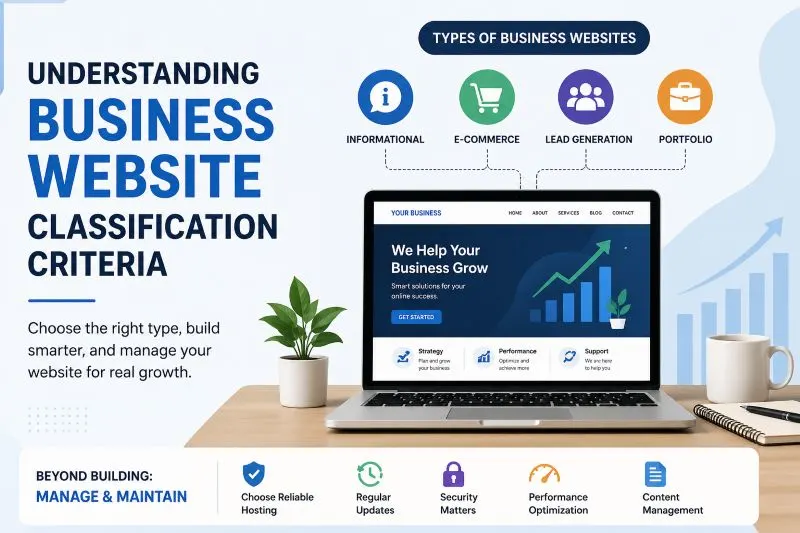
Business Website Classification Criteria Without Overthinking It
Ever landed on a business website and instantly felt like, “okay, this is legit”… or the exact opposite? That reaction isn’t random. It usually comes down to how that website fits into certain business website classification criteria, even if we don’t consciously think about it that way. I’ve seen small businesses struggle with this. They build a site, but it feels off, like it’s trying to do too many things at once. The truth is, not all business websites are meant to function the same way. Once you understand how they’re classified, things start to click. Why Website Classification Actually Matters You might be thinking, does classification really matter that much? Short answer, yes. It shapes everything, from design to content to how people interact with your business. A few common types you’ll notice: Informational websites that just explain services E-commerce websites focused on selling products Lead generation websites built to collect inquiries Portfolio websites showing past work When a business mixes these without clarity, the result is confusion. Visitors don’t know what to do next, and that usually means they leave. A clear classification gives your website direction. Without it, even a beautiful design can fail. How Hosting Quietly Influences Your Website Type This part gets ignored a lot. People treat hosting like a boring technical step, but it actually affects how your website performs within its category. For example: A slow host can ruin an e-commerce experience Weak security makes lead generation risky Limited resources can break dynamic features If your site is meant to handle bookings, payments, or user accounts, you need hosting that supports that purpose. I’ve seen a small clothing store try to run on cheap hosting. The site kept crashing during sales. Customers gave up. That’s not just a technical issue, that’s a classification mismatch. Choosing Hosting Based on Your Website Type Instead of picking hosting randomly, match it to your site’s role. So how to pick a hosting. Ask yourself: Is my site mostly static or interactive? Will I get heavy traffic or occasional visitors? Do I need fast load times for conversions? For example: A simple informational site can run on basic hosting An online store needs speed, uptime, and security A service business needs reliability for lead capture This is where business website management starts to feel more practical. It’s not just updating content, it’s making sure the foundation supports your goals. Local Hosting and Why It Can Matter More Than You Think If your audience is local, hosting closer to them can actually improve performance. Take businesses targeting customers in a specific region. A locally optimized setup can mean: Faster loading times Better user experience Slight SEO advantages It’s not always essential, but in competitive markets, small improvements add up. Would your customers wait 5 seconds for your site to load? Probably not. Common Mistakes People Keep Making This is the part where most frustration comes from. Here are a few patterns I’ve noticed: Trying to turn one website into everything Ignoring performance because “it looks good” Choosing the cheapest hosting without thinking long term Not updating or maintaining the site regularly That last one is huge. Small business website maintenance often gets neglected, and suddenly the site feels outdated or broken. Then there’s another group, businesses without websites, still relying only on social media. That might work for a while, but it limits control and credibility. A Real-Life Scenario You’ve Probably Seen A local bakery sets up a website. At first, it’s just a simple page with photos and contact info. That’s fine. It’s an informational site. Then they add online ordering, then blog posts, then event bookings. Now it’s trying to be three different types of websites at once. Customers get confused. Orders fail. The site slows down. The problem isn’t growth. It’s lack of clarity in classification. So, Where Should You Start? If your website feels messy or underperforming, don’t jump straight into redesigning it. Start by asking: What is this website supposed to do, really? Once you answer that, everything else becomes easier. Hosting, design, content, even maintenance decisions start aligning naturally. And honestly, that’s the whole point of understanding business website classification criteria. Not to sound technical, but to make smarter, simpler choices that actually work. At the end of the day, your website doesn’t need to do everything. It just needs to do the right thing, well.
Should I Form an LLC for My Side Hustle? (2026 Guide)
Confused about protecting your gig income? Learn if an LLC makes sense for your side hustle in 2026, from a fellow gig worker.